
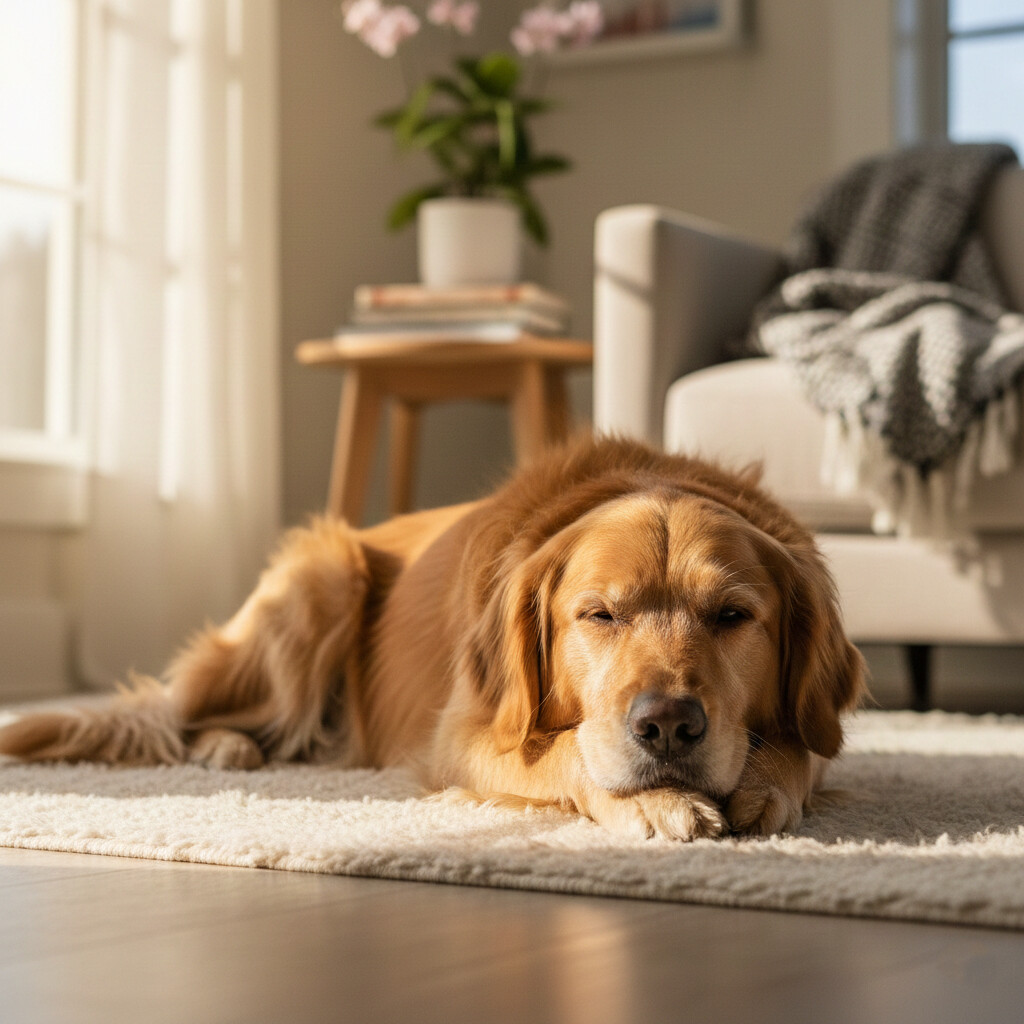
A dog sigh usually means one of two things, depending on their facial expressions and body language. If your dog sighs with half-closed eyes and a relaxed body, it is a sign of contentment and pleasure, typically signaling the end of an activity. However, if your dog sighs with eyes wide open and looks at you expectantly, it signals disappointment or frustration, often because they didn’t get a treat, walk, or play session they wanted.
Summary Table
| Type of Sigh | Eye State | Body Language | Meaning | What You Should Do |
| Contentment | Half-closed or fully closed | Lying down, head on paws, relaxed ears | Pure relaxation, happiness, feeling safe | Let them rest; they are happy. |
| Disappointment | Wide open, looking at you | Alert posture, ears perked or slightly back | Frustration, “I give up,” impatience | Ignore it if training; engage if they need activity. |
| Exhaustion | Heavy eyelids | Heavy breathing, sprawling out | Tiredness after exercise or stress | Ensure they have fresh water and a quiet bed. |
| Medical Distress | Strained or panicked | Whining, wheezing, lethargy, refusal to eat | Pain, respiratory issue, discomfort | Consult a vet immediately. |
What It Means When a Dog Sighs
Dogs communicate with us constantly. While we often focus on barks, whines, and growls, the quieter sounds are just as important. One of the most common yet misunderstood sounds is the sigh. You have probably heard it a hundred times: your dog circles their bed, flops down, rests their head on their paws, and lets out a long, audible exhale.
Is it boredom? Are they sad? Are they happy?
To understand what your dog is saying, you have to look at the whole picture. Unlike humans, who might sigh primarily out of stress or sadness, dogs use this vocalization to express a range of emotional and physical states.
This guide will walk you through exactly how to interpret these sounds and what your dog is trying to tell you.
Read Also: Why Do Dogs Stare at Their Owners?
Context Is King: How to Read the Signs
Before you can interpret a sigh, you need to look at what just happened. Context is the most critical factor in reading canine body language. A sigh doesn’t happen in a vacuum. It is usually a punctuation mark at the end of a sentence.
To get an accurate reading, ask yourself these three questions:
- What was the dog doing just before the sigh? (Playing, begging for food, or getting ready to sleep?)
- What are the dog’s eyes doing? (Are they open and alert, or soft and closing?)
- What is the dog’s body posture? (Tense and ready to move, or loose and melted into the floor?)
By combining these clues, you can determine if your dog is entering a state of relaxation or a state of resignation.
1. The Sigh of Contentment
This is the most common reason for a dog to sigh, and it is the one every dog owner loves to hear. This sigh usually happens after a period of activity or when the dog is settling in for a nap.
How to spot it:
- The Eyes: Your dog’s eyelids will be heavy, drooping, or completely closed. They have a “soft” expression on their face.
- The Ears: The ears are in a neutral or relaxed position, not perked up listening for sounds.
- The Body: The dog is lying down. They usually lower their head onto their front paws before releasing a long exhale. Their muscles are loose.
The Meaning:
When a sigh is paired with relaxation, it signifies a transition. Your dog is telling you, “I am safe, I am happy, and I am ready to rest.” It is a sign of deep emotional satisfaction. You will often hear this after a long walk, a good meal, or a cuddle session on the couch.
Scientific Note:
Physiologically, this sigh helps the dog lower their heart rate and deepen their breathing to prepare for sleep. It is the body’s way of hitting the “reset” button to enter a calm state.
2. The Sigh of Disappointment and Frustration
On the flip side, dogs are emotional toddlers. They know what they want, and when they don’t get it, they express their displeasure. This type of sigh is less about relaxation and more about resignation.
How to spot it:
- The Eyes: This is the biggest giveaway. The eyes will be wide open. The dog is often looking directly at you or at the object they desire (like a treat jar or a leash).
- The Body: The dog might be lying down, but their head is often up, or they might be sitting. Their body tension is higher than in a contented dog. They are alert.
- The Timing: This happens when you refuse a request. Perhaps they brought you a ball, and you didn’t throw it. Maybe they sat by the door, and you didn’t take them out.
The Meaning:
In this context, the sigh translates to, “Fine, I guess I won’t get what I want.” It is an active communication signal. They are ending an effort. They tried to communicate a need or want, but it wasn’t met, so they are audibly “giving up” for the moment.
While we call this “disappointment,” it is not necessarily a negative emotion like human sadness. It is simply a shift in behavioral gear, moving from “active engagement” to “passive waiting.”
3. The Sigh of Exhaustion
Just like humans, dogs sigh when they are physically wiped out. This is distinct from contentment because it is driven by physical need rather than emotional peace.
How to spot it:
- Breathing: The sigh might be accompanied by faster or heavier breathing beforehand.
- Recent Activity: This happens immediately after intense exercise, like a game of fetch, a run, or roughhousing with other dogs.
- Sprawling: Instead of curling up neatly, an exhausted dog often “flops” onto their side, fully extending their legs.
The Meaning:
This is a physiological release. The body is expelling excess carbon dioxide and taking in a large amount of oxygen to recover from exertion. It signals that the dog is done with physical activity for the time being and needs to recharge.
4. Sighs vs. Groans vs. Moans
It is easy to confuse a sigh with other low-pitched vocalizations. However, differentiating them is key to understanding your dog’s health and mood.
The Groan:
A groan is deeper and more guttural than a sigh. It often has a vocal cord vibration involved (a slight growling sound mixed with a sigh).
- Meaning: Usually occurs when a dog is settling down, similar to an old man sitting in a comfortable chair. It is typically a sign of comfort. However, if a dog groans while standing up or moving, it could indicate arthritis or joint pain.
The Moan:
A moan is a prolonged, low sound that can happen while the dog is awake or asleep.
- Meaning: If the dog is asleep, it is likely dreaming. If the dog is awake and moaning without being touched, it can be a sign of deep contentment (like a cat purring). If the dog moans when you touch a specific spot, it signals pain.
When Should You Worry? (Medical Warning Signs)
While 90% of sighs are behavioral, you should never ignore a sigh that seems “off.” Since dogs mask pain well, vocalizations are sometimes the only clue we get that something is wrong physiologically.
If the sighing is frequent, persistent, or accompanied by other symptoms, it may not be a sigh at all; it could be wheezing or labored breathing.
Red Flags to Watch For:
- Whistling sound: If the exhale makes a whistling or rattling noise, this could indicate a blockage in the airway or bronchitis.
- Grimacing: If the dog sighs and immediately flinches, licks a joint, or looks uncomfortable.
- Lethargy: If the dog sighs and refuses to move, eat, or play for extended periods.
- Coughing: A sigh that turns into a cough can be a sign of heart disease or tracheal collapse, especially in small breeds.
If you notice these signs, the “sigh” is likely a symptom of dyspnea (difficulty breathing) or chronic pain. You should schedule a visit to the veterinarian immediately.
How to Respond to Your Dog’s Sighs
Now that you know what the sighs mean, how should you react? Your reaction shapes your dog’s future behavior.
Responding to the Contented Sigh
Do nothing! Or, do very little. If your dog sighs while curling up next to you, a gentle, slow stroke down their back is a great way to bond. It reinforces that they are safe and you are sharing in their relaxation. Do not startle them or speak in a high-pitched voice, or you will break the mood.
Responding to the Frustrated Sigh
This depends on your training goals.
- If you want to maintain boundaries: Ignore it. If you give in to the sigh and give them the treat or throw the ball, you are teaching them that “sighing = reward.”
- If you forgot a need: If the dog is sighing by the water bowl and it is empty, or by the door and they haven’t been out, acknowledge it. This is helpful communication.
Responding to the Exhausted Sigh
Ensure they have access to fresh water nearby so they don’t have to get up if they are thirsty. Leave them alone to recover.
Read Also: Common Puppy Behavior Problems (And Solutions)
Deep Dive: The Science of Canine Vocalization
Why do dogs make these sounds at all? Evolutionarily, dogs developed a complex vocal range to communicate with their pack (and later, their human pack).
Research into canine behavior suggests that vocalizations like sighs are “low-cost” signals. Barking and growling take energy and aggression. Sighing is a passive way to signal emotional state without escalating a situation. It allows dogs to maintain social harmony.
When a dog sighs in a social setting (like with other dogs), it acts as a “calming signal.” It tells the other dogs, “I am settling down, I am not a threat, and I am not looking to play right now.” This helps prevent misunderstandings and fights within the pack.
Frequently Asked Questions
Do certain breeds sigh more than others?
Yes. Breeds with more vocal personalities, such as Huskies, Beagles, and German Shepherds, tend to vocalize their feelings more often, including sighs and groans.
Additionally, brachycephalic breeds (flat-faced dogs like Pugs and Bulldogs) may sigh more audibly due to their anatomy, though owners must distinguish this from breathing difficulties.
Why does my dog sigh when I hug him?
This is context-dependent. If he leans into you and sighs with soft eyes, he is enjoying the affection. If he stiffens his body, looks away, and sighs with wide eyes, he is tolerating the hug but feeling stressed. He is sighing to release the tension of the interaction.
Is yawning the same as sighing?
No. While a sigh can be relaxation or frustration, a yawn in dogs is frequently a sign of stress or anxiety. If a dog yawns repeatedly in a new environment, it is trying to calm themselves down. However, a yawn before bed is just a sign of tiredness.
Do puppies sigh?
Absolutely. Puppies actually sigh quite frequently. Because they expend massive amounts of energy in short bursts, their “power down” mode is very sudden. You will often see a puppy play hard, collapse, sigh loudly, and fall asleep instantly.
Conclusion
Understanding your dog’s sighs is a wonderful way to deepen the bond between you. It allows you to move beyond basic commands and understand the emotional life of your pet.
Next time your dog lets out a heavy breath, pause and observe. Look at those eyes. Check the ears. Are they telling you they are perfectly happy, or are they wishing you’d finally throw that tennis ball? By paying attention to these subtle cues, you become a better, more empathetic best friend to your dog.