
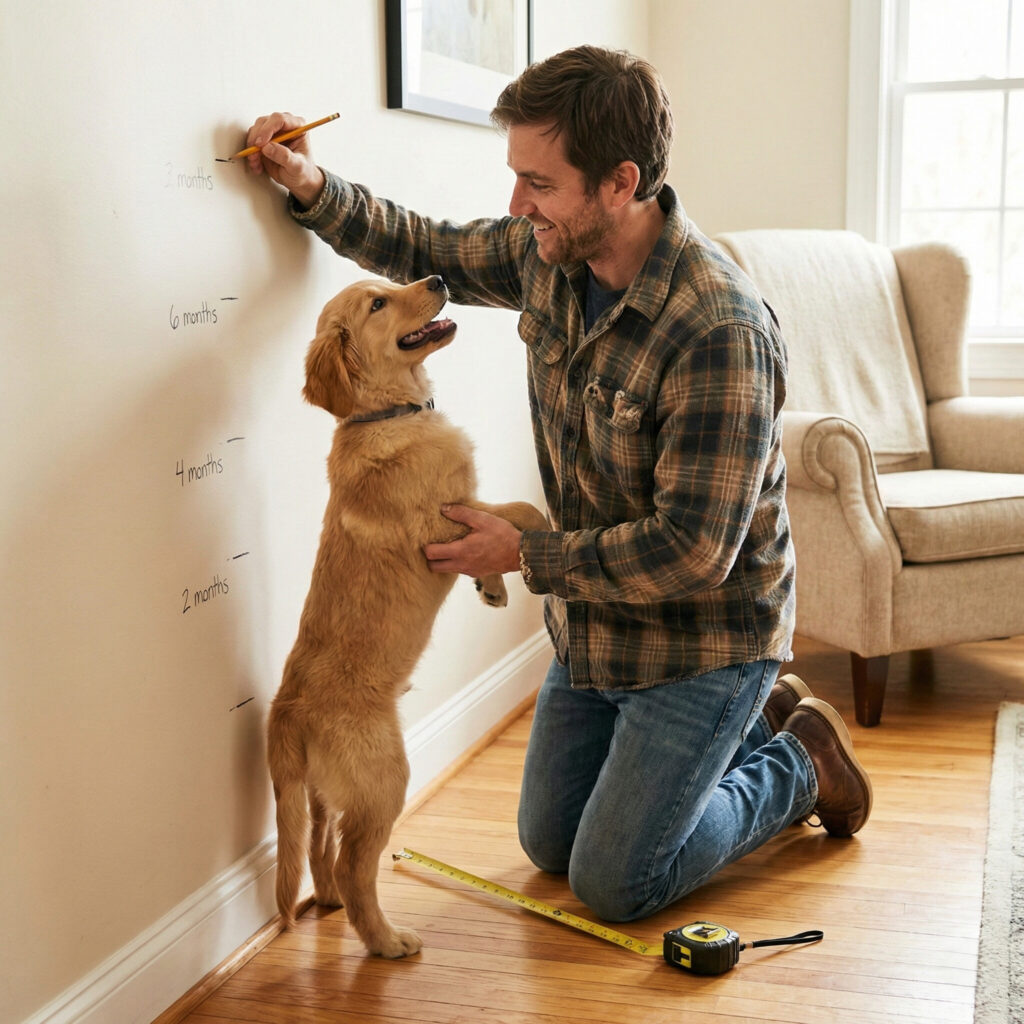
A puppy’s growth spurt is a short period where your dog experiences rapid physical development, growing significantly in height and weight. These spurts typically occur between two and five months of age, though the timing varies by breed size. During a spurt, your puppy may sleep more, eat more, and appear physically uncoordinated or “lanky.” While small breeds reach full size quickly (often by 10–12 months), large and giant breeds experience multiple growth spurts and may not stop growing until 18–24 months.
Summary Table
| Breed Size | Typical Weight | Most Rapid Growth Period | Reaches Full Height | Reaches Full Weight/Fill |
| Toy/Small | Under 20 lbs | 0–11 weeks | 6–9 months | 8–12 months |
| Medium | 21–50 lbs | 0–16 weeks | 12 months | 12–15 months |
| Large | 51–90 lbs | 0–20 weeks | 15–18 months | 18–24 months |
| Giant | Over 90 lbs | 0–25 weeks | 18–24 months | 24–36 months |
Puppy Growth Spurts Explained
Watching a puppy grow is one of the most exciting parts of owning a dog. One day, they fit in the palm of your hand, and the next, they can barely fit in their crate. However, growth is rarely a steady, straight line. Instead, puppies tend to grow in sudden bursts followed by plateaus.
Understanding these growth spurts is vital for more than just tracking their size. It helps you understand their behavior. If your puppy is suddenly sleeping all day or acting grumpy, they might be busy growing bone and muscle.
This guide covers the science of puppy growth, specific timelines for different breeds, and how to support your dog through diet and exercise.
Read Also: How to Help a Puppy Adjust to a New Home?
The Science Behind the Spurt
Biologically, a growth spurt is driven by the pituitary gland releasing growth hormones. These hormones signal the body to create new tissue, specifically in the bones and muscles.
This process requires a massive amount of energy. That is why the two biggest indicators of a growth spurt are sleep and hunger. Your puppy isn’t being lazy; their body is working overtime at a cellular level.
The most critical area of growth happens at the epiphyseal plates, commonly known as growth plates. These are soft, cartilage-like areas at the ends of the long bones (legs). As the puppy grows, these plates produce new bone cells, lengthening the legs. Eventually, these plates calcify and harden, signaling the end of skeletal growth.
Timeline: When Do Growth Spurts Happen?
The timeline of growth spurts depends almost entirely on the breed size of your dog. Genetics dictate how fast a dog grows and when it stops.
Toy and Small Breeds
Examples: Chihuahuas, Pomeranians, Pugs.
Small dogs grow very quickly. They do not have the long, drawn-out growth phases of larger dogs.
- The Spurt: The most intense growth happens between birth and 11 weeks.
- The Finish Line: Most small breeds are near their full adult height by 6 to 8 months. They may continue to fill out (gain muscle and fat) until they are one year old, but the vertical growth is largely done.
Medium Breeds
Examples: Beagles, Border Collies, Cocker Spaniels.
Medium dogs follow a slightly longer curve.
- The Spurt: You will see massive changes between 8 and 16 weeks.
- The Finish Line: They usually reach adult height around 12 months, with chest filling and muscle development continuing until 15 months.
Large Breeds
Examples: Labradors, Golden Retrievers, German Shepherds.
These dogs have a much longer road to maturity.
- The Spurt: They have a major spurt between 3 and 6 months, but they often have a secondary, smaller spurt around 8 to 10 months.
- The Finish Line: They generally reach full height by 15 to 18 months. However, they will look “lanky” for a long time and will not reach their full adult weight until closer to two years old.
Giant Breeds
Examples: Great Danes, Mastiffs, Saint Bernards.
Giant breeds have the most complex growth requirements. They grow rapidly, but their growth plates stay open much longer.
- The Spurt: They grow explosively from 2 to 6 months. A Great Dane puppy can gain several pounds a week.
- The Finish Line: They take the longest to mature. Skeletal growth may continue until 18 or 24 months. It can take up to three full years for a giant breed to reach its final “filled out” weight.
Read Also: When Puppies Develop Fear Periods
5 Signs Your Puppy is in a Growth Spurt
How do you know if your dog is just tired or if they are growing? Look for these five common symptoms.
1. The “Sleeping Beauty” Phase
Puppies normally sleep a lot (15 to 20 hours a day), but during a growth spurt, this might increase. Deep sleep is when growth hormones are released most efficiently. If your energetic puppy suddenly wants to nap after every meal, let them. Never wake a sleeping puppy; their body needs that downtime to build bone density.
2. The Bottomless Stomach
You might put down their bowl of food, turn around, and find it empty in seconds. As their metabolism spikes to fuel new tissue production, their calorie needs skyrocket. If your puppy is scouring the floor for crumbs immediately after dinner, they are likely in a spurt.
3. The “Puppy Uglies.”
This is a term breeders use to describe the awkward phase of physical development. Different body parts grow at different rates.
- Ears: The ears might suddenly look too big for the head.
- Legs: The back legs might grow faster than the front legs, making the puppy look like they are running downhill (this is called being “high in the rear”).
- Paws: Their paws may look massive compared to their ankles. Don’t worry, their body will eventually catch up and proportion themselves out.
4. Clumsiness (The “Zoomie” Crash)
Because their legs are getting longer day by day, puppies literally have to relearn how to walk and run. Their center of gravity changes. You might notice them tripping over their own paws, bumping into doorframes, or sliding on hardwood floors more often.
5. Regression in Training
Sometimes, physical growth distracts from mental focus. A puppy that was sitting perfectly last week might stare at you blankly today. This isn’t necessarily disobedience; their brain is occupied with physiological changes. Be patient and consistent with your training commands during this time.
Growing Pains: Are They Real?
Yes, puppies can experience discomfort associated with growing, often referred to as “growing pains.”
The most common medical condition associated with this is Panosteitis (often called “Pano”). This is an inflammation of the outer surface of the long bones in the legs. It is most common in large and giant breeds like German Shepherds.
Symptoms of Pano
- Shifting Lameness: One day, your puppy is limping on their front left leg; two days later, they are limping on the back right. The pain shifts from leg to leg.
- Reluctance to Walk: They may hesitate to go for walks or refuse to play.
- Touch Sensitivity: They may yelp if you squeeze their legs.
If you suspect Pano, visit your vet. It is usually a self-limiting condition (meaning it goes away on its own when the growth spurt ends), but your vet can prescribe pain management to help your puppy feel comfortable.
Nutrition: What to Feed a Growing Puppy
Fueling a growth spurt is not just about giving more food; it is about giving the right food.
The Calcium/Phosphorus Balance
This is the most critical factor, especially for large-breed puppies. If a puppy grows too fast, their bones can become less dense, leading to joint issues like hip dysplasia later in life.
- Too much Calcium: Can cause bone deformities.
- Too little Calcium: Can cause stress fractures. You need a high-quality puppy food that has a balanced ratio of calcium to phosphorus (usually around 1.2:1).
Puppy Food vs. Adult Food
Do not switch to adult dog food too early. Puppy formulations are higher in protein and fat to support tissue building.
- Small Breeds: Switch to adult food around 9–12 months.
- Large Breeds: Switch to adult food around 12–18 months (or use a “Large Breed Puppy” formula, which is specifically designed to control rapid growth).
Weight Management
It is tempting to overfeed a hungry puppy, but keeping them lean is better for their long-term health. An overweight puppy puts excessive stress on their soft growth plates. You should be able to feel their ribs but not see them.
Read Also: How Puppies Learn Social Boundaries
Exercise Safety: Protecting the Growth Plates
While your puppy has the “zoomies,” you must be the “fun police” to protect their joints. Because their growth plates are soft, high-impact activities can cause permanent damage.
Avoid these activities until growth plates close:
- Forced Running: Do not take your puppy for long jogs on pavement. Self-directed play (where the puppy stops when tired) is fine; forced running is not.
- Jumping: Do not encourage jumping off furniture, out of cars, or catching frisbees in the air. The landing impact is too hard on developing elbows and shoulders.
- Stairs: Minimize repetitive stair climbing, especially for breeds prone to back or hip issues (like Dachshunds or Labradors).
Safe Exercises:
- Short, sniffing walks (mental stimulation is tiring!).
- Swimming (low impact and great for muscle building).
- Free play on grass or soft surfaces.
Mental Changes During Growth Spurts
Growth spurts often coincide with fear periods and hormonal shifts.
The Fear Period (8–11 weeks and 6–14 months)
You might notice your confident puppy suddenly becomes terrified of a trash can or a stranger. This is a natural evolutionary developmental stage.
- What to do: Do not coddle them, but do not force them to face the fear. Let them observe from a distance and reward bravery with treats.
Teething (3–6 months)
This often happens alongside the first major growth spurt. Your puppy loses baby teeth and grows adult teeth. Their mouth hurts, so they chew on everything.
- What to do: Provide frozen carrots or specialized teething toys to soothe their gums.
When Does It All Stop?
How do you know when your dog is officially “done”?
Most owners look at height, but that is only half the story. A dog is not fully physically mature until their growth plates have closed and it has “filled out.”
- Height: Usually stops first.
- Muscle/Bulk: Continues for months after height stops.
- Coat: The adult coat (especially for fluffy breeds) may not fully come in until 2 years of age.
If you are planning to spay or neuter your dog, your vet may recommend waiting until the growth plates have closed. This is increasingly common for large breeds, as early neutering can affect the hormones that regulate bone growth, potentially leading to taller, lankier dogs with joint issues.
Conclusion
Puppy growth spurts are a rollercoaster of sleeping, eating, and clumsiness. While it can be worrying to see your puppy limping or acting lethargic, it is usually just a sign that their body is hard at work.
By understanding the timeline for your specific breed and monitoring their diet and exercise, you can ensure they grow into strong, healthy adults.
Remember to take plenty of photos; these growth spurts move fast, and before you know it, that awkward, lanky stage will be a distant memory.