
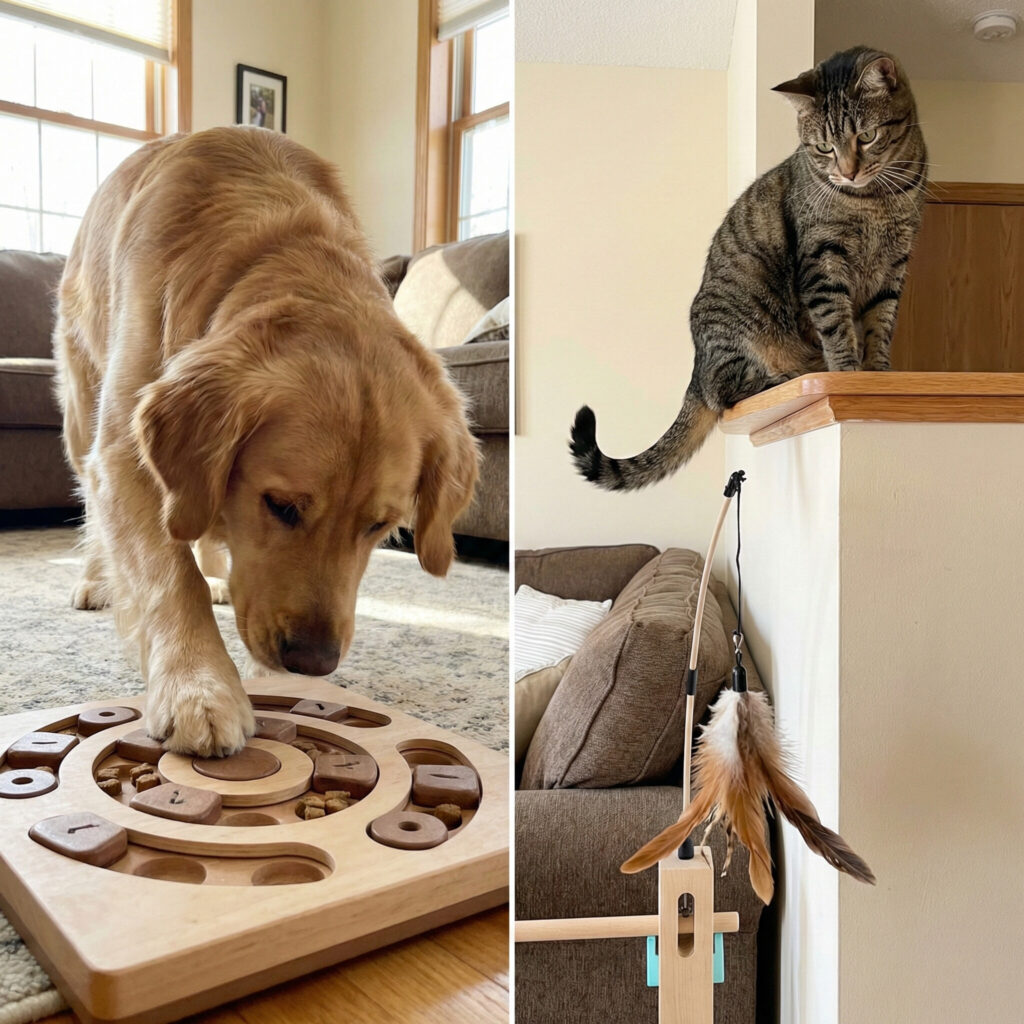
When comparing problem-solving skills in dogs versus cats, neither species is universally “smarter.” They use fundamentally different strategies rooted in their evolutionary history. Dogs are “social problem-solvers.” When faced with a difficult task, they quickly turn to humans for help, utilizing their ability to read human cues like pointing and gazing. Cats are “independent problem-solvers.” They rarely look to humans for assistance and instead rely on persistence and physical trial-and-error to manipulate objects and solve the problem themselves. Dogs excel at cooperative tasks, while cats excel at solitary tasks requiring patience and physical manipulation.
Summary Table
| Feature | Dogs (Canis lupus familiaris) | Cats (Felis catus) |
| Ancestral Background | Pack animals (wolves), cooperative hunters. | Solitary predators (wildcats), ambush hunters. |
| Primary Strategy | Social cooperation. They use humans as a tool to solve the problem. | Independent action. They rely on their own physical efforts and persistence. |
| Reaction to “Unsolvable” Tasks | They quickly give up trying physically and “look back” at their human for help. | They persist for a long time, trying to manipulate the object themselves. They rarely look for help. |
| Human Interaction Cues | Excellent. They highly grasp pointing, gazing, and verbal commands. | Moderate to Low. They understand some cues but often choose to ignore them if not immediately rewarding. |
| Best At | Tasks requiring teamwork, following directions, and navigating social hierarchies. | Tasks requiring physical manipulation of objects, patience, and stealth. |
| Key Cognitive Strength | Social Intelligence. | Physical/Mechanical Intelligence. |
Problem-Solving Skills: Dogs vs Cats
The debate over whether dogs or cats are “smarter” is endless among pet owners. However, science suggests that asking which animal is smarter is the wrong question. Intelligence isn’t a single ladder where one species sits higher than another. It is more like a toolbox.
Dogs and cats have different toolboxes because they evolved in very different ways. Their brains are wired to solve the problems their ancestors faced in the wild. Today, when our pets face a challenge, like retrieving a treat from under a sofa or opening a door, they revert to those deep-seated instincts.
Understanding these differences doesn’t just settle a bar bet. It helps us appreciate our pets for who they are and trains us to communicate with them better. This article explores the fascinating science behind how dogs and cats approach problems.
Read Also: Cat vs Dog Memory: Who Remembers Better?
The Background
To understand how a dog or a cat thinks today, we have to look at where they came from thousands of years ago. This evolutionary history is the foundation of their current cognitive skills.
The Dog
Over thousands of years, we bred dogs that paid close attention to us. We became their new “pack.” Therefore, a dog’s brain is primed to solve problems by working with others, especially humans.
The Cat
Cats were not domesticated in the same way as dogs were. They mostly “domesticated themselves,” hanging around human settlements to eat rodents. We didn’t actively breed them to cooperate with us for tasks like hunting or herding. Therefore, a cat’s brain is primed to solve problems alone through self-reliance.
Dog Problem-Solving
If you give a dog a difficult puzzle, its primary problem-solving tool is often you. Dogs are masters of social cognition. This means they think about what others are thinking and use that information.
The Importance of the “Look Back”
Researchers have conducted many experiments where they give an animal an impossible task. For example, they might put food inside a box that cannot be opened.
When a wolf is faced with this locked box, it will try to rip it open with its teeth and claws until it gets exhausted. When a dog faces the same locked box, it tries for a few seconds, realizes it doesn’t work, and then stops. It turns around and makes eye contact with its human owner.
This behavior is called the “look back.” It isn’t a sign of failure or stupidity. It is a highly sophisticated social strategy. The dog is effectively saying, “I can’t do this. You are bigger and have thumbs. Fix this for me.” The dog recognizes the human as a tool that can be used to solve the problem.
Reading Human Cues
Dogs are arguably better at understanding human gestures than any other animal, including chimpanzees.
- The Pointing Test: If you hide food under one of two cups and point to the correct cup, a dog will almost immediately understand that your finger is directing their attention to the reward. Most cats (and wolves) struggle with this; they look at your finger, not at where your finger is pointing.
- Gaze Following: Dogs watch our eyes. If we stare intently at something, a dog will likely look in that direction too. They understand that what we are looking at is important.
These skills mean dogs solve problems in a human world by asking for directions and following them.
Read Also: Dog vs. Cat Communication Styles
Cat Problem-Solving
Cats approach problems like the solitary hunters they are. They do not naturally see humans as helpers in a task. If they want something, they believe they must get it themselves.
The Power of Persistence
In the same “locked box” experiment mentioned above, the cat’s reaction is distinct from the dog’s. When a cat realizes it can’t easily open the box to get the food, it doesn’t look at its owner.
Instead, the cat persists. It will paw at the box, scratch it, bite it, sit on it, and try different physical angles. They show remarkable tenacity. While the dog gives up physically to try a social strategy, the cat keeps trying physically.
In the wild, giving up too soon means starving. This persistence is a vital problem-solving trait for a lone predator.
Physical Manipulation and Trial-and-Error
Because cats don’t rely on social cues, they are often better at mechanical puzzle-solving through trial and error. They are “paws-on” learners.
- Opening Doors: Many cat owners know the struggle of a cat that has figured out how to open cabinets or lever-style door handles. They usually learn this not by watching us, but by repeatedly jumping at the handle until something happens. They learn through direct physical interaction with the environment.
- Puzzle Feeders: Cats can be excellent at complex puzzle feeders that require sliding panels or spinning wheels. They experiment with their paws until they find the action that releases the kibble.
Cats solve problems by interacting directly with the obstacle until it yields.
Head-to-Head: Key Cognitive Comparisons
We can look at specific cognitive skills to see how the two species stack up against each other.
- Memory: Both dogs and cats have excellent long-term memories, especially regarding spatial locations (where food is found) and emotional events (scary situations). There isn’t a significant difference in their general memory capacity.
- Object Permanence: This is the understanding that an object still exists even when you can’t see it. (Like knowing your keys are still in your pocket even though they are hidden). Both species have this ability. However, some studies suggest cats might be slightly better at tracking invisible displacements, which makes sense for an animal hunting prey that frequently darts into burrows or behind cover.
- Cause and Effect: Both understand basic cause and effect. (If I push this ball, it rolls). However, dogs are better at linking a human’s action to an effect, while cats are focused on their own actions causing an effect.
- Trainability vs. Problem-Solving: It is crucial not to confuse trainability with problem-solving intelligence. Dogs are generally easier to train because they are motivated by social praise and want to cooperate. Cats are harder to train because they are motivated almost exclusively by what’s in it for them (usually food) and don’t care about pleasing a human. Being “stubborn” is not the same as being “dumb.”
Read Also: How Cats and Dogs React to Strangers
The “Intelligence” Debate: Reframing the Question
If you judge a fish by its ability to climb a tree, it will live its whole life believing it is stupid. This famous quote applies perfectly to the dog vs. cat debate.
If we define “problem-solving” as the ability to work with humans to achieve a goal, dogs win easily. Their brains have been reshaped by domestication to align with ours. They are experts at navigating a human-centric world by using their social connection to us.
If we define “problem-solving” as the ability to independently manipulate the physical environment to overcome an obstacle without help, cats often have the edge. They are self-reliant mechanical thinkers who don’t wait for a bailout.
Why it seems like dogs are smarter:
We, humans, are intensely social creatures. We solve problems by talking to each other and collaborating. Because dogs use a strategy that mirrors our own, we instinctively view them as “smarter.” We recognize their thinking process. When a cat ignores us and tries to solve a problem alone, we sometimes mistake their independence for a lack of understanding.
Conclusion
So, who has better problem-solving skills? Neither. They just have different skills.
The dog is the ultimate social diplomat, using cooperation as a survival strategy. The cat is the ultimate lone wolf (ironically), using self-reliance and physical persistence.
Recognizing these differences is key to being a good pet owner. If your dog is struggling with a puzzle toy, give them a hint; they are waiting for it. If your cat is struggling, sit back and let them figure it out; interfering might just annoy them.
By understanding how their brains are wired, we can appreciate the unique genius of both our canine and feline companions.