
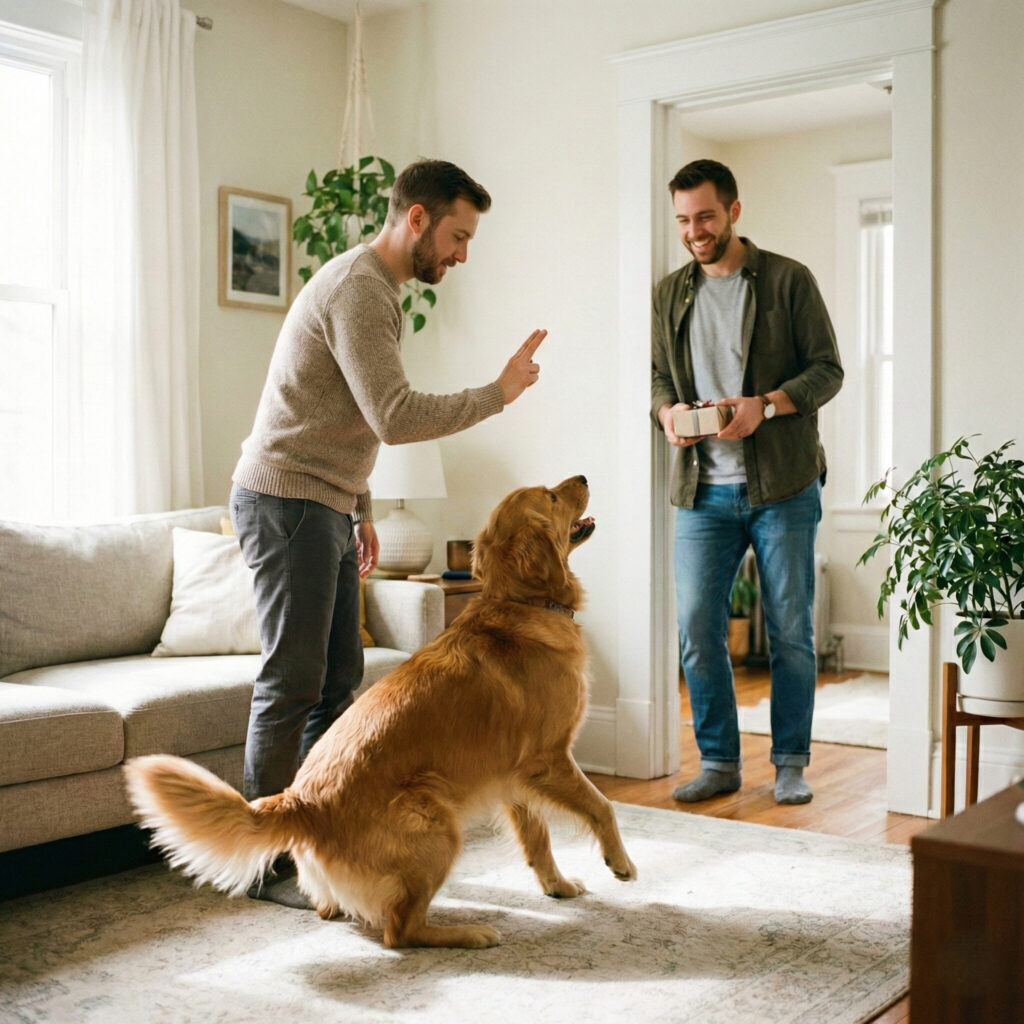
To stop a dog from jumping, remove the reward (attention) immediately. When the dog jumps, turn your back, cross your arms, and remain silent. Do not make eye contact or push them away. Wait for all four paws to touch the floor. Once they are standing calmly or sitting, immediately reward them with praise and a treat. Consistently rewarding “four on the floor” teaches the dog that calmness earns attention, while jumping makes attention disappear.
Summary Table
| Technique | How It Works | Best For |
| The Turn Away | You ignore the dog completely until they stop jumping. | Mildly excited dogs or attention seekers. |
| Sit to Say Hello | The dog must sit before getting any attention or pets. | Dogs that already know the “Sit” command well. |
| The Leash Anchor | Stepping on a leash prevents the dog from physically jumping up. | Large dogs or persistent jumpers. |
| Scatter Feeding | Tossing treats on the floor keeps the dog’s focus downwards. | High-energy dogs entering a room. |
| Gating | Physically separating the dog from guests until calm. | Safety management for overly exuberant dogs. |
Why Dogs Jump on Guests
Before fixing the behavior, it helps to understand it. Dogs are not trying to be dominant or rude. Jumping is a natural greeting behavior for canines. Puppies jump at their mothers to lick their faces, which is a sign of affection and a request for food. When they jump on humans, they are often trying to get closer to our faces to say hello.
More importantly, jumping works. Even if you push the dog off or yell “No,” you are touching them and looking at them. To a dog, this counts as attention. If they are bored or excited, negative attention is better than no attention.
To stop the jumping, you must change the outcome so that jumping yields zero results, while keeping feet on the floor yields high-value rewards.
Read Also: What to Do If Your Dog Is Stubborn
Management: Preventing the Jump Before It Happens
Training takes time. While your dog is learning, you need “management” techniques. These prevent the dog from practicing the bad habit. Every time your dog manages to jump on a guest and gets a reaction, the behavior is reinforced.
Use a Leash Inside
When you know guests are coming, put your dog on a leash before they open the door. This gives you physical control. You can keep the dog close to you and prevent them from rushing the guest.
Baby Gates and Crates
If your dog gets overly excited (hyper-aroused) when the doorbell rings, do not let them greet guests immediately. Place them behind a baby gate or in a crate with a stuffed food toy. Let the guests enter and settle down. Once the excitement of the arrival has passed, bring the dog out on a leash.
The “Be a Tree” Method
Instruct your guests ahead of time. Tell them: “If he jumps, please be a tree.” This means they should stand still, look up at the ceiling, and cross their arms. This removes all stimulation for the dog.
Training Technique 1: Four on the Floor
This is the golden rule of greeting. Attention is only given when all four paws are touching the ground.
- Set the Stage: Tether your dog to a sturdy piece of furniture or have a helper hold the leash. This prevents them from actually making contact with you if they jump.
- Approach: Walk toward the dog calmly.
- The Trigger: If the dog lifts its front paws off the ground, immediately stop and take two steps backward.
- The Reset: Wait. The dog will likely look confused. Eventually, they will put their paws back down.
- The Reward: The moment the paws hit the floor, say “Yes!” or “Good!” and step forward to give a treat or a calm pet.
- Repeat: If you step forward and they jump again, back up again. You are teaching them that jumping acts like a “reverse button” for humans. The only way to make the human come closer is to keep feet on the floor.
Training Technique 2: Sit to Say Hello
This is an “incompatible behavior.” A dog cannot be sitting and jumping at the same time. If you teach them that sitting is the only key that unlocks the door to greeting, they will default to sitting.
Step-by-Step Guide
- Start with no distractions (no guests yet).
- Walk up to your dog. If they are standing, ask for a “Sit.”
- When they sit, praise calmly and pet them slowly on the chest (not the head, which can invite jumping).
- If they break the sit and pop up, immediately stand up straight and withdraw your hands.
- Wait for them to sit again.
- Resume petting.
Adding the Doorbell
Once the dog masters this with you, add the doorbell trigger. Ring the bell, then ask for a seat. Reward heavily. You want the sound of the doorbell to become a cue that means “Run to the door and sit nicely,” rather than “Go crazy.”
Read Also: How to Train a Dog With High Energy
Training Technique 3: The Scatter Feed
This is excellent for dogs that are too food-motivated or excited to focus on a “Sit” command. It keeps their nose and feet on the ground.
- Preparation: Keep a jar of high-value treats near the front door.
- The Entry: As soon as a guest walks in, immediately toss a handful of treats on the floor away from the guest.
- The Logic: The dog hears the treats hit the floor and immediately looks down to sniff and eat. This prevents the initial eye-contact and jump.
- The Greeting: By the time the dog finishes the “treasure hunt,” the guest is inside and settled, and the initial spike of excitement has dropped.
Training Technique 4: The Leash Anchor
For large dogs where jumping can be dangerous or painful, use the leash anchor method.
- Put the dog on a standard 6-foot leash.
- Step on the leash about halfway down.
- Give the dog enough slack to stand comfortably and sit, but not enough slack to jump up.
- When the guest approaches, if the dog tries to jump, the leash physically prevents them. They hit a “ceiling” of tension.
- As soon as they settle back down, reward them.
- Crucial Note: Do not yank the leash. Your foot simply acts as an anchor. The dog corrects themselves by hitting the limit of the leash.
Proofing: Making it Work with Real Guests
Dogs are bad at generalizing. Just because they don’t jump on you doesn’t mean they won’t jump on your Grandma. You need to practice with different people.
The Setup
Invite a friend over specifically for training. Do not invite someone who just wants to hang out. Explain that the goal is training, not socializing.
The Practice Run
- Have your friend knock.
- Open the door with your dog on a leash.
- If the dog jumps, have the friend turn their back immediately.
- Reset the dog.
- Have the friend turn around and try again.
- Repeat this 10-15 times.
- End on a success where the dog sits and gets a treat from the guest.
Common Mistakes to Avoid
Many old-school dog training pieces of advice actually make jumping worse. Avoid these common errors.
Kneeing the Dog in the Chest
This is outdated and dangerous. It can injure the dog or cause them to become fearful of you. For some sturdy breeds, they might even interpret this as roughhousing and jump harder.
Squeezing the Paws
Some people suggest grabbing the dog’s front paws and squeezing them until the dog pulls away. This can damage the trust between you and your dog. It also doesn’t teach them what to do instead.
Yelling “Down!” or “No!”
Yelling adds chaotic energy to an already chaotic situation. It ramps up the excitement. Also, in dog training, “Down” usually means “lie down on your belly.” If you use “Down” for “get off me,” you confuse the dog. Use “Off” for getting off furniture or people, and “Down” for lying down.
Inconsistency
You cannot let the dog jump on you when you are wearing casual clothes, but get mad when it jumps on your work clothes. The dog does not understand fashion. The rule must be: Jumping on humans is never allowed, ever.
Read Also: Why Some Dogs Ignore Commands Outside
The Role of High-Value Treats
When training impulse control (stopping yourself from doing something you want to do), dry kibble often isn’t enough. The reward for jumping (greeting the human) is very high. Your food reward must be higher.
Use “high-value” treats for greeting training. These are soft, smelly, and rare.
- Boiled chicken
- String cheese
- Freeze-dried liver
- Hot dogs (in small moderation)
Save these specific treats only for guests coming over. This makes the dog focus on you (“Where is the chicken?”) rather than the guest (“I want to jump!”).
Troubleshooting Stubborn Jumpers
My dog jumps when I come home from work.
Keep a jar of treats outside your door or in your car. Grab a handful before you walk in. Throw them inside immediately as you open the door. This redirects their energy to the floor instantly.
My guest won’t listen and encourages the dog to jump.
This is common. People say, “Oh, I don’t mind! I love dogs!” You must be firm. Tell them, “I mind. He is in training, and he gets muddy footprints on my grandmother. Please turn your back.” If the guest refuses to follow the rules, put the dog on a leash or in another room. You are your dog’s advocate.
My dog jumps on strangers on the street.
Do not let your dog meet strangers on a leash until they are calm. If someone asks to pet your dog, say, “Yes, but only if he sits.” Ask your dog to sit. If they break the sit to jump, say “Sorry, he’s learning,” and walk away. The reward of meeting the stranger must be earned by sitting.
Coclusion
Stopping a dog from jumping is not an overnight fix. It requires patience and consistency from every member of the household. If Dad lets the dog jump but Mom doesn’t, the dog becomes a gambler, jumping just in case this is the person who allows it.
Remember the core formula:
- Jumping = Person disappears (turns away).
- Four paws on the floor = Person appears + Treats.
With time, your dog will realize that the fastest way to get the love and attention they crave is to keep their feet firmly planted on the ground.