
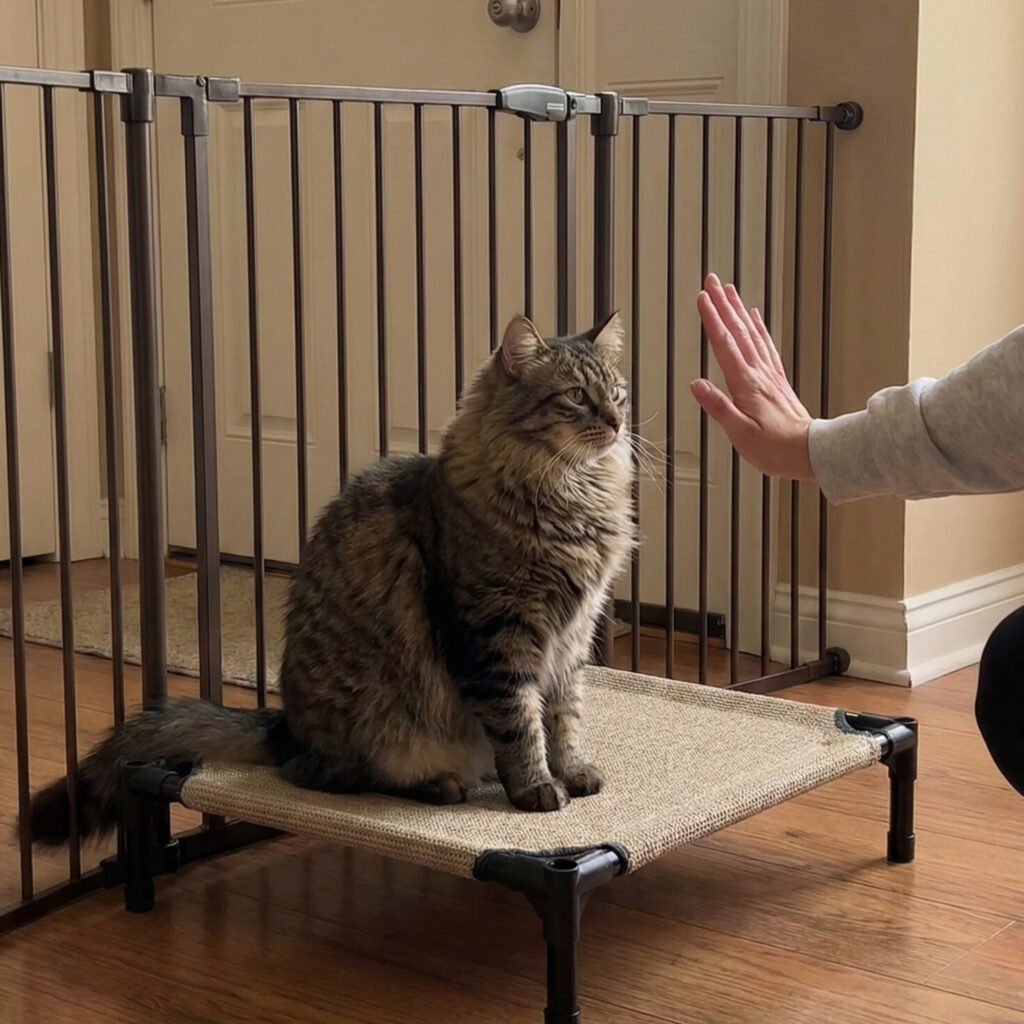
To stop a cat from door dashing you must combine management techniques with positive reinforcement training. Start by spaying or neutering your cat to reduce hormonal roaming urges and install physical barriers like baby gates or an “airlock” system. Simultaneously train an incompatible behavior such as sitting on a specific mat or tower away from the door for a high value treat whenever the door opens. Increasing indoor enrichment with puzzle feeders and vertical climbing spaces will also reduce their desire to escape.
Summary Table
| Strategy | Purpose | Difficulty Level | Time to See Results |
| Spay/Neuter | Removes hormonal urge to mate and roam | Vet required | Teaches the cat to go to a mat instead of the door |
| The “Spot” Training | Reduces boredom and curiosity about the outside | Moderate | 2 to 4 weeks |
| Desensitization | Reduces excitement around door opening cues | Easy | 1 to 2 weeks |
| Physical Barriers | Physically blocks the cat from the exit | Easy | Immediate |
| Enrichment | Reduces boredom and curiosity about outside | Easy | Ongoing |
Why Cats Dash Out the Door
Before you can fix the behavior, you need to understand the motivation. Cats are not trying to run away from you specifically. They are usually driven by instinctual needs that are not being met inside the house.
Read Also: How to Help a Cat Adjust After Moving Homes
1. Curiosity and Boredom
Cats are natural explorers. The world outside the door is full of changing smells, sights, and sounds. If their indoor environment is static and unchanging, they will naturally want to investigate the stimulating world outside. This is common in strictly indoor cats who do not have enough toys or vertical territory.
2. The Mating Instinct
An intact male cat will do almost anything to get outside if he smells a female in heat. This biological drive is incredibly strong and nearly impossible to train away.
Similarly, a female cat in heat will try to escape to find a mate.
3. Territorial Patrol
Some cats view the yard or hallway as part of their territory. They may feel the need to patrol the perimeter to mark it or check for intruders. This is often triggered if they see neighborhood cats through the window.
Fear or Stress
In some cases, a cat might dash to escape a stressful situation inside, such as a loud vacuum cleaner, a new aggressive pet, or chaotic visitors.
Immediate Management Strategies
While you are working on long term training, you need to prevent escapes immediately. Every time your cat succeeds in dashing out, the behavior is reinforced because they get the reward of exploring. You must break this cycle.
1. Create an Airlock Entryway
An airlock is a double-door system. If you have a mudroom or a porch, use it. Enter the first door and close it completely before opening the second door into the main house. If you do not have a built-in room, you can create a temporary airlock using tall tension gates or exercise pens placed around the front door.
2. Use Visual Blockers
Sometimes the sight of the outdoors is the trigger. If you have a glass storm door, apply a frosted window film to the bottom half. This lets light in but blocks the view of squirrels or other cats, which lowers your cat’s arousal levels before you even open the door.
3. Post Signage for Guests
Visitors do not know your cat is a dasher. Put a clear sign on your front door that says “Stop! Cat Inside. Please Enter Slowly.” This prevents guests from flinging the door wide open and giving your cat a clear path to escape.
4. Cat Proofing the Exit
Keep a spray bottle of water or a can of compressed air near the door solely for emergencies. If the cat rushes as you enter, a quick noise or spritz can deter them. However, this is a management tool and not a training method because it does not teach them what they should do instead.
Training the “Go to Place” Command
This is the most effective long term solution. You will teach your cat that a specific spot away from the door is a high value location. This is an incompatible behavior because a cat cannot be sitting on their mat and running out the door at the same time.
Step 1: Choose the Spot
Select a location about 5 to 10 feet away from the door. It should be elevated if possible as cats prefer high vantage points. A cat tree, a sturdy stool, or a specific training mat works well.
Step 2: Charge the Spot
Without opening the door, stand near the spot with high value treats like boiled chicken or freeze dried liver. Lure your cat onto the spot. As soon as all four paws are on it, say “Yes” or use a clicker and give them the treat. Repeat this 10 to 20 times per session until the cat eagerly jumps on the spot when you approach it.
Step 3: Add the Cue
Once the cat is offering the behavior, start saying a command word like “Place” or “Mat” right before they jump up. Say “Mat,” wait for them to jump, click or say “Yes,” and treat. Practice this daily for one week.
Step 4: Introduce Door Movement
Now you will add the distraction of the door. Have the cat go to their mat and reward them. Walk toward the door. If they stay on the mat, toss a treat to them. If they get up, ask them to go back to the mat and try again, but do not go as close to the door this time.
Step 5: Touch the Doorknob
Ask your cat to go to the mat. Walk to the door and touch the knob. Do not turn it. If the cat stays, look at them and toss a treat. Repeat this until the sound of you touching the knob does not make them move.
Step 6: Open the Door Slightly
This is the hardest step. Ask for “Mat.” Open the door just one inch and immediately close it. Reward the cat heavily for staying. Gradually increase how wide you open the door and how long it stays open. If the cat breaks the stay, simply close the door and start over. They learn that the door only opens when they are on their mat.
Read Also: Why Do Cats Shed More in Certain Seasons?
Desensitizing Departure Triggers
Cats are smart. They know that putting on shoes, grabbing keys, or picking up a bag means the door is about to open. These actions build anticipation and adrenaline.
To fix this, you need to decouple these cues from the actual event of leaving.
1. The Keys Game
Pick up your keys. Jingle them loudly. Then put them down and go sit on the couch. Do not leave. Do this 5 times a day. Eventually, the sound of keys will become meaningless background noise to your cat.
2. The Shoe Fake Out
Put on your shoes and coat. Walk around the house for a few minutes then take them off and sit down. This teaches the cat that shoes do not always equal an open door.
3. Exit Without Excitement
When you actually do leave, keep it low energy. Do not say a long goodbye or use a high-pitched voice. Simply give them a treat on their training mat and walk out quietly.
4. Enrichment to Reduce Roaming Urges
A bored cat is a flight risk. If you make the inside of your house more interesting than the outside the desire to dash will decrease significantly.
5. Vertical Territory
Cats feel confident when they are high up. Install shelving, window perches, or tall cat trees. This allows them to survey their territory without needing to go outside to patrol. A window perch with a bird feeder outside provides “Cat TV” which engages their mind safely.
6. Food Puzzles and Hunting Games
Stop feeding your cat from a bowl. Use puzzle feeders, lick mats, or hide small piles of dry food around the house. This forces them to forage and hunt for their meals which burns mental energy. A tired cat is less likely to have the energy to speed towards the door.
7. Interactive Play
Play with your cat for at least 15 minutes twice a day using a wand toy. Make the toy move like a bird or mouse. Allow them to catch it and “kill” it. Follow this play session with a meal.
This mimics the natural Hunt Catch Kill Eat Sleep cycle and encourages them to nap near the door rather than dash through it.
Catios and Leash Training
If your cat is desperate for fresh air, give it to them safely.
Building a Catio
A “catio” or cat patio is an enclosed outdoor space. It can be a simple window box or a large screened in porch. This gives them the smells and breeze they crave without the danger of cars or predators.
Harness Training
You can train your cat to walk on a harness and leash. This allows you to take them out the door in a controlled manner. It also teaches them that the only time they go outside is when they are wearing the harness. If they are not wearing it, they do not get to go out.
Safety Nets: Microchips and Collars
Even with the best training accidents happen. You must be prepared for the worst case scenario.
Microchipping
A microchip is the only permanent form of identification. It is injected under the skin between the shoulder blades. Ensure your contact information is up to date in the registry. If your cat dashes and gets lost a shelter or vet can scan the chip to find you.
Breakaway Collars
Have your cat wear a collar with an ID tag. The tag should have your phone number and address. Ensure the collar is a “breakaway” style which unclips if it gets snagged on a branch or fence to prevent choking.
Read Also: Why Do Cats Hide in Small, Dark Spaces?
What to Do If Your Cat Escapes
If your cat does dash out, panic is your enemy. Do not chase them.
1. Stop and Drop
If you run after a cat, they will run faster because they think it is a game or they are being hunted. Instead, stop moving and crouch down. Offer a high value treat or shake their food jar.
2. Leave the Door Open
If safe to do so, leave the door cracked open. Often, a cat will dash out, realize it is scary or cold, and try to run back in immediately.
3. The Scent Lure
If they are gone longer than a few minutes, place their litter box and bedding outside by the door. The familiar scent can help guide them home from a distance.
4. Search at Dawn and Dusk
Cats are crepuscular, meaning they are most active at dawn and dusk. This is the best time to search for them with a flashlight. Look under porches, cars, and in bushes near your home. Indoor cats usually do not go far and will hide in silence when frightened.
Conclusion
Stopping a cat from door dashing requires patience and consistency. It is rarely a quick fix. By removing the hormonal drive through spaying or neutering, managing the environment with barriers, and actively training an alternative behavior like sitting on a mat, you can keep your cat safe.
Remember that enrichment is key. A satisfied and entertained cat is a cat that is happy to stay indoors. Start your training today with short sessions and always reward the behavior you want to see.