
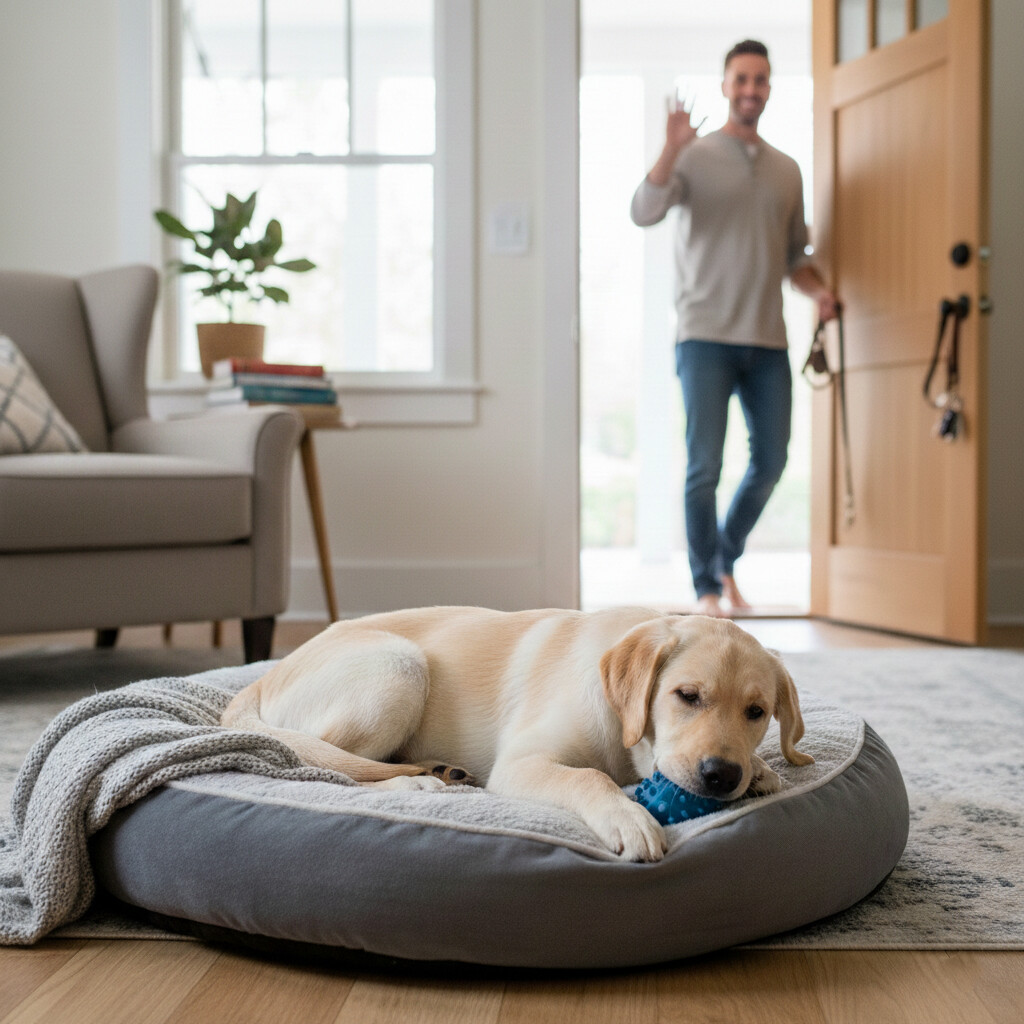
To prevent separation anxiety in puppies, gradually acclimate them to being alone by starting with short intervals and increasing time slowly. Create a safe, comfortable space like a crate or playpen, and use positive reinforcement. Desensitize them to departure cues like grabbing keys, avoid emotional goodbyes or greetings, and ensure they receive adequate physical exercise and mental stimulation before you leave.
Summary Table: Preventing Separation Anxiety in Puppies
| Strategy | Key Action | Goal |
| Safe Space | Establish a crate or puppy-proof room. | Creates a secure “den” where the puppy feels safe alone. |
| Desensitization | Pick up keys or put on shoes without leaving. | Breaks the association between these actions and you disappearing. |
| Gradual Departure | Leave for 30 seconds, then 1 minute, etc. | Builds tolerance to separation slowly without triggering panic. |
| Low-Key Exits | Leave without saying goodbye; ignore puppy on return. | Normalizes coming and going so it isn’t an emotional event. |
| Mental Stimulation | Use puzzle toys or Kongs when leaving. | Distracts the puppy and creates a positive association with being alone. |
How to Prevent Separation Anxiety in Puppies?
Bringing a new puppy home is exciting, but it comes with challenges. One of the most common issues new owners face is canine separation anxiety. This condition occurs when a dog becomes distressed and panicked when separated from their guardian. It can lead to destructive chewing, endless barking, and house soiling.
The good news is that preventing separation anxiety is much easier than fixing it later. By teaching your puppy that being alone is safe and normal, you set them up for a lifetime of confidence.
This guide covers the essential steps to raise an independent, happy dog using positive reinforcement and consistent training methods.
Read Also: When Can Puppies Start Going Outside?
Understanding Puppy Psychology
Before diving into the “how-to,” it helps to understand the “why.” Dogs are pack animals. In the wild, being left alone is dangerous for a puppy. Their instinct is to cry out so their mother can find them. When you bring them home, you become their family. It is natural for them to want to be with you constantly.
Your goal isn’t to force them to be alone, but to teach them that you always come back. You are rewriting their instinct to show them that solitude is safe and can even be enjoyable.
Phase 1: Creating a Safe Zone
You cannot expect a puppy to relax if they have the run of the entire house. They need a designated “safe zone.” This is usually a crate or a playpen.
Why Crate Training Matters
Crate training is one of the most effective tools for preventing anxiety. A crate acts as a den. It is a cozy, enclosed space where the puppy can retreat to sleep and relax.
- Location: Place the crate in a quiet corner of a busy room (like the living room) so they aren’t isolated immediately.
- Comfort: Add soft bedding (if they don’t chew it) and an item of clothing that smells like you.
- Association: Never use the crate for punishment. The crate should be the place where good things happen.
The “High-Value” Treat Method
To make the safe zone appealing, give your puppy a special treat that they only get when they are in their crate or pen. A hollow rubber toy (like a Kong) stuffed with peanut butter or wet food is excellent. Licking is soothing for dogs and keeps them occupied for 20 to 30 minutes.
Phase 2: Desensitizing Departure Cues
Dogs are masters of observation. They learn your routine better than you know it. They know that when you put on your shoes, grab your keys, or pick up your coat, you are about to leave.
For an anxious puppy, these actions act as triggers that start the panic before you even open the door.
You need to “break” these triggers.
The Mock Departure Routine
Perform your leaving rituals without actually leaving.
- The Keys: Pick up your car keys. Walk around the room. Put them back down. Sit on the couch. Do this 5 times a day until the puppy ignores the noise.
- The Shoes: Put on your shoes. Walk to the kitchen to get a glass of water. Take your shoes off.
- The Coat: Put on your coat. Sit down and watch TV for two minutes. Take the coat off.
- The Door: Walk to the front door. Turn the knob. Let go. Walk away.
Eventually, the puppy will stop seeing these actions as a signal that you are vanishing. They become meaningless background noise.
Phase 3: The Gradual Departure Technique
Once the puppy is comfortable in their crate and isn’t panicking at the sight of your keys, you can start leaving. The trick is to start so small that the puppy doesn’t have time to get upset.
Step-by-Step Duration Training
- Step 1: The Invisible Barrier. Place the puppy in their safe zone with a chew toy. Step out of their sight but stay in the room (e.g., behind a couch or chair). Stay hidden for 10 seconds. Reappear. Treat.
- Step 2: The Doorframe. Step out of the room completely. Wait 30 seconds. Return.
- Step 3: The Front Door. Step out the front door and close it. Wait 1 minute. Return.
- Step 4: The Mail Run. Go outside for 5 minutes (walk to the mailbox or around the block). Return.
- Step 5: The Grocery Run. Leave for 20 minutes.
Important Rule: If the puppy whines or barks, do not go back in immediately. If you return while they are barking, you teach them that “Barking = Human Comes Back.” Wait for a brief moment of silence (even 3 seconds) before returning. If they panic instantly, you have moved too fast. Go back to the previous step.
Phase 4: Managing Emotions (Yours and Theirs)
How you act when you leave and return defines the puppy’s emotional state. Humans tend to make big emotional displays. We say, “Oh my poor baby, Mommy will miss you so much, be a good boy!” using a high-pitched voice. Then, when we return, we throw a party, hugging and kissing the jumping puppy.
This creates anxiety. It highlights the contrast between “You are here (PARTY!)” and “You are gone (SADNESS).”
The “Be Boring” Rule
- Leaving: Be completely neutral. Do not talk to the dog, do not make eye contact, and do not touch them for 5 minutes before you leave. Just walk out the door.
- Returning: When you come home, ignore the puppy. This is hard, but necessary. Walk in, put your keys away, take off your coat, and wait until the puppy is calm and has all four paws on the floor. Only then should you calmly pet them.
By making your comings and goings a “non-event,” the puppy learns that your absence is no big deal.
Phase 5: Exercise and Enrichment
A tired puppy is a good puppy. If your puppy is full of pent-up energy, they are much more likely to be anxious and destructive. You must meet their physical and mental needs before asking them to be alone.
Physical Exercise
Before you leave the house for a longer period, ensure the puppy has had a good walk or a vigorous play session. A puppy who is ready for a nap is a puppy who won’t mind you leaving.
Mental Stimulation
Brain games are often more tiring than walking.
- Snuffle Mats: Hide dry food in a fabric mat for them to sniff out.
- Training: 10 minutes of practicing “sit,” “stay,” and “down.”
- Puzzle Toys: Toys that require the dog to slide levers to get treats.
Read Also: Why Do Dogs Lick Their Owners?
Teaching Independence While You Are Home
Separation anxiety prevention isn’t just about when you leave the house. It is about “isolation distress.” Some puppies can’t even handle being in a different room from their owner.
The “Place” Command
Teach your puppy a “Place” or “Mat” command. This tells them to go to a specific bed and stay there.
- Put a mat on the floor.
- Lure the puppy onto it with a treat. Say “Place.”
- When they lie down, reward them.
- Slowly increase the distance you can walk away while they stay on the mat.
This teaches the puppy self-regulation. They learn to settle themselves down even when you are busy cooking or working on the computer, rather than constantly being under your feet or in your lap.
Common Mistakes to Avoid
Even well-meaning owners make mistakes that can trigger separation anxiety.
- Never Punish Anxiety: If you come home and find the puppy has chewed the sofa or had an accident, do not yell or punish them. They did not do it out of spite; they did it out of panic. Punishment will only increase their anxiety the next time you leave.
- Inconsistent Routine: Puppies thrive on predictability. Try to keep a consistent schedule for meals, potty breaks, and alone time.
- Sleeping in the Bed Too Soon: While cuddling is great, letting a young puppy sleep in your bed every night can create a hyper-attachment. Have them sleep in their crate or own bed until they are confident and independent.
When to Seek Professional Help
Sometimes, despite your best efforts, a puppy may have genetic predispositions to anxiety or may have had a traumatic experience before you adopted them.
If you see these signs, it is time to consult a Certified Professional Dog Trainer (CPDT) or a Veterinary Behaviorist:
- Self-injury (breaking teeth on crate bars, scratching doors until paws bleed).
- Escaping the crate consistently.
- Refusing to eat high-value treats when you are not there.
- Howling or barking for hours without stopping.
Conclusion
Preventing separation anxiety is an investment in your dog’s future happiness. It requires patience, consistency, and a little bit of “tough love” (ignoring those sad puppy eyes when you leave).
By creating a positive association with the crate, desensitizing them to your departure cues, and keeping your exits low-key, you are giving your puppy the tools to be a confident, independent adult dog.
Remember, a dog that is comfortable being alone is a dog that is truly free to enjoy their life with you. Start small, stay calm, and trust the process.