
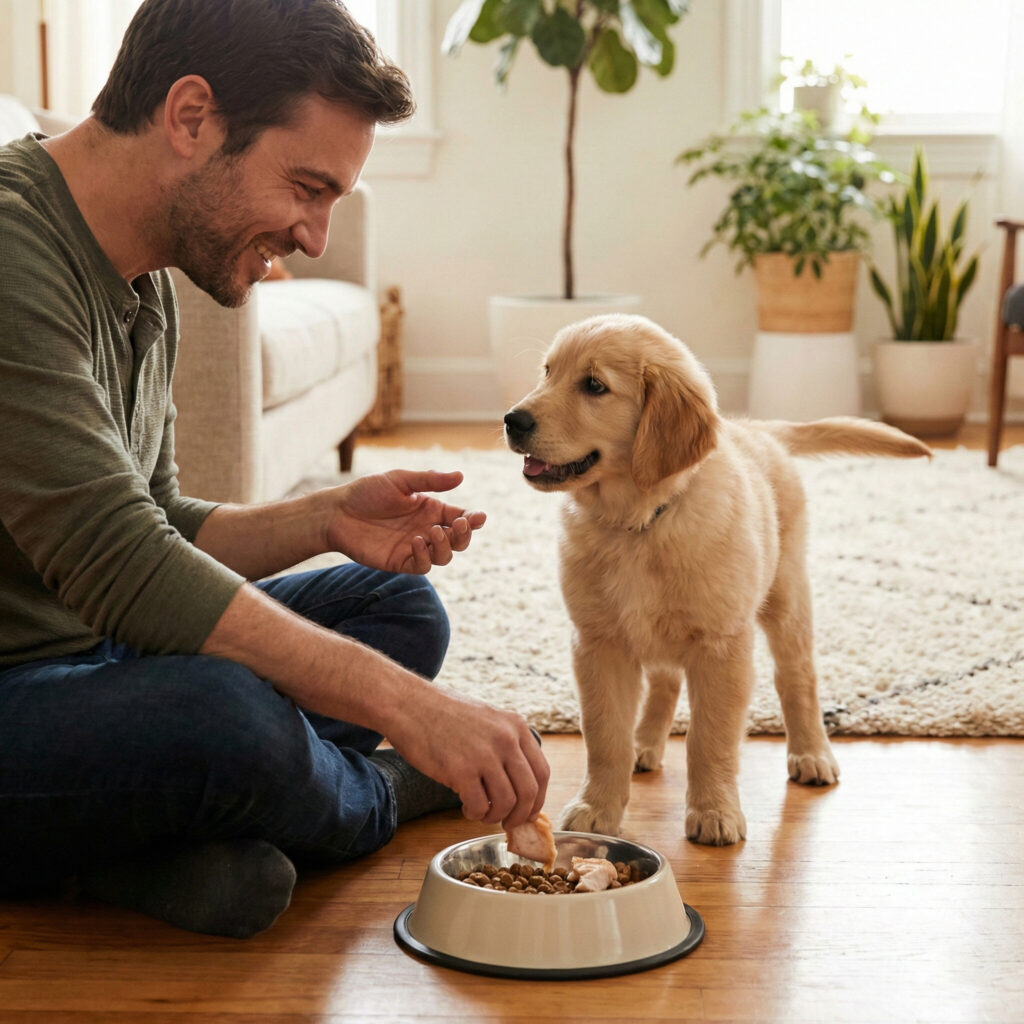
To prevent resource guarding in puppies, use positive reinforcement to teach them that human presence near their valued items leads to rewards, not loss. Implement “trading games” where you exchange a low-value chew for a high-value treat, then return the chew. Always approach the food bowl to drop extra tasty food in, rather than taking the bowl away. Never punish a growling puppy, as this suppresses warning signals and increases anxiety.
Summary Table
| Key Concept | Description |
| What is it? | A natural instinct to protect valuable items (food, toys, space) from others. |
| Golden Rule | Teach the puppy that your approach = getting something better, not losing what they have. |
| Key Method | The “Trade Up” game (swapping a low-value item for a high-value treat). |
| Major Mistake | Punishing the growl or forcibly taking items away without trading. |
| Early Signs | Stiff body, “whale eye” (showing whites of eyes), freezing, eating faster. |
| When to Start | Immediately. Prevention is much easier than curing established aggression. |
How to Prevent Resource Guarding in Puppies
Resource guarding is one of the most common behavioral issues in dogs. It stems from a natural survival instinct: in the wild, if an animal didn’t guard its food, it starved. However, in a human home, this behavior can become dangerous.
The goal of prevention is to change the puppy’s emotional response. Instead of thinking, “Oh no, he’s coming to steal my bone,” your puppy should think, “Yay, he’s coming! That means I get chicken!”
This guide details the steps to “immunize” your puppy against resource guarding through management, training exercises, and proper body language interpretation.
Read Also: Common Puppy Health Concerns
What is Resource Guarding
Resource guarding occurs when a dog reacts aggressively or defensively to keep control of a valued item. This “resource” can be food, a toy, a sleeping spot, or even a specific person.
Common Guarded Resources
- Food bowls and kibble
- Bones and bully sticks
- Laundry (socks, shoes)
- Furniture (couches, beds)
- The owner (guarding you from other dogs or people)
It is crucial to understand that a puppy growling over a bone is not “dominating” you. They are simply afraid of losing their prize.
Recognizing the Early Signs
Guard behavior usually starts subtly before escalating to biting. Catching these signs early allows you to intervene safely.
The Ladder of Aggression:
- Freezing: The puppy stops chewing or moving completely when you approach.
- Eating Faster: They gulp food quickly to finish before you get there.
- Body Blocking: Turning their head or body away to shield the item.
- Whale Eye: You see the whites of their eyes as they look at you without turning their head.
- Stiffening: Muscles become tense and rigid.
- Growling/Snapping: The final warning before a bite.
Core Strategy 1: The Food Bowl Exercises
Many owners accidentally create guarding by sticking their hands in the bowl to “show who’s boss.” This often backfires. Instead, you want to be the giver of food, not the taker.
Step 1: The Approach and Drop
Do not mess with the puppy while they are eating. Instead, teach them that your approach adds value.
- Give the puppy their meal in a bowl.
- Walk past the puppy while they are eating. Do not stop.
- Drop a piece of high-value treat (chicken, cheese, freeze-dried liver) near the bowl.
- Keep walking.
- Repeat this 2-3 times per meal.
The Result: The puppy learns that footsteps approaching the bowl signal that something delicious is about to rain from the sky.
Read Also: How Puppies Learn From Adult Dogs
Step 2: The Approach and Speak
Once the puppy looks happy (wagging tail, loose body) when you walk by, add verbal cues.
- Approach the puppy while they eat.
- Say their name or “Good boy.”
- Drop the high-value treat right into the bowl.
- Walk away immediately.
Core Strategy 2: The “Trade Up” Game
This is crucial for preventing guarding of items like bones, socks, or toys. You must teach the puppy that giving up an item results in a reward, and usually getting the item back.
The Mechanics of Trading
Never rip an item out of a puppy’s mouth unless it is immediately life-threatening. For everything else, trade.
How to Execute a Proper Trade:
- Identify the Value: If the puppy has a chew toy (Level 5 value), you need a treat that is better (Level 10 value, like a hot dog or steak).
- Present the Reward: Place the high-value treat right in front of the puppy’s nose so they can smell it.
- The Drop: The puppy will naturally open their mouth to eat the treat, dropping the toy.
- Mark and Reward: As soon as the toy hits the floor, say “Drop” or “Out” and let them eat the treat.
- The Return: While they chew the treat, pick up the toy. Then, and this is critical, give the toy back.
Why give it back?
If you always take the item away permanently, the puppy learns the trick is a trick. If you give it back 90% of the time, the puppy learns they get a treat plus their toy. They have no reason to guard it.
Core Strategy 3: Desensitizing to Touch
Puppies need to be comfortable with humans touching them while they possess a resource. This prevents “handling aggression.”
- The Pet and Treat: While the puppy is chewing a low-value bone, briefly stroke their back.
- Immediate Reward: Immediately drop a high-value treat between their front paws.
- Retreat: Remove your hand and walk away.
- Progression: Gradually work up to touching the collar, lifting an ear, or touching a paw, always following the touch with a high-value treat.
Note: If the puppy freezes or growls, you have moved too fast. Go back to just walking by and dropping treats.
Read Also: How Puppies Learn From Adult Dogs
What To Do If Your Puppy Steals “Contraband”
Puppies often steal forbidden items like socks, tissues, or shoes. Your reaction here sets the stage for future guarding.
The “Chase” Mistake
If you chase the puppy, two things happen:
- It becomes a fun game of keep-away.
- The puppy learns they must be fast and defensive to keep their prize.
The Correct Response
- Ignore: If the item is safe (like a piece of paper or an old sock), often the best strategy is to ignore it. Without your attention, the item becomes boring.
- Redirect: Grab a favorite squeaky toy or ball. Run away from the puppy, making excited noises. The puppy will likely drop the boring sock to chase the fun owner.
- The Emergency Trade: If they have something dangerous (like a battery or medication), grab a handful of high-value treats and scatter them on the floor away from the object. This is a “treat bomb.” While the puppy eats the scatter, calmly remove the dangerous item.
The Role of Environmental Management
Prevention is also about removing the opportunity to fail. If a puppy practices guarding, the behavior becomes stronger.
- Feed in Peace: Do not let children or other pets bother the puppy while eating. Give them a safe, quiet zone (like a crate or pen).
- Pick Up Valuables: Keep shoes, laundry, and kids’ toys off the floor.
- Monitor High-Value Chews: Only give bones or bully sticks when you can supervise. If the puppy looks tense, do not approach. Wait until they abandon the item to pick it up.
Why Punishment Fails
Using physical punishment or yelling at a growling puppy is dangerous.
The Suppression Effect
Growling is a form of communication. It means “I am uncomfortable, please give me space.” If you punish the growl, the puppy stops growling but remains uncomfortable. Next time, they may skip the growl and go straight to biting.
Eroding Trust
Punishment confirms the puppy’s fear: “I was right, humans are dangerous when I have food.” This increases anxiety and makes the guarding worse in the long run.
When to Seek Professional Help
While prevention is possible for most owners, some puppies have a genetic predisposition to severe resource guarding. You should contact a certified professional dog trainer (CPDT) or a veterinary behaviorist if:
- Drawing Blood: The puppy has bitten and broken skin.
- Stiffness: The puppy goes rigid every time you enter the room while they are eating.
- Escalation: The behavior is getting worse despite your “trading” efforts.
- Multiple Triggers: The puppy guards food, toys, sleeping spots, and water bowls simultaneously.
Frequently Asked Questions
Should I put my hand in the food bowl to get them used to it?
No. This is an outdated method that causes annoyance and anxiety. Imagine if someone kept putting their hand on your plate while you tried to eat dinner. You would eventually get angry.
My puppy growls when I try to move him off the couch. Is this resource guarding?
Yes, this is “location guarding.” Use a lure (a tasty treat) to guide them off the couch. Say “Off,” lure them down, and reward them when their paws hit the floor. Do not physically drag them off.
Can I stop resource guarding between two dogs?
You can manage it. Feed dogs in separate rooms or crates. Remove all high-value toys and bones when the dogs are together. Only allow play with neutral items that neither dog guards.
Will neutering fix resource guarding?
Not necessarily. Resource guarding is a behavioral issue driven by fear and instinct, not just hormones. While neutering has health benefits, training is the cure for guarding.
Conclusion
Preventing resource guarding is about building a bank account of trust. Every time you trade a treat for a toy or drop chicken into a food bowl, you make a deposit into that account.
Eventually, the puppy trusts you implicitly. They learn that humans are not thieves; they are the source of all good things.
By respecting their natural instincts and using smart psychology rather than force, you can raise a safe, confident, and generous dog.