
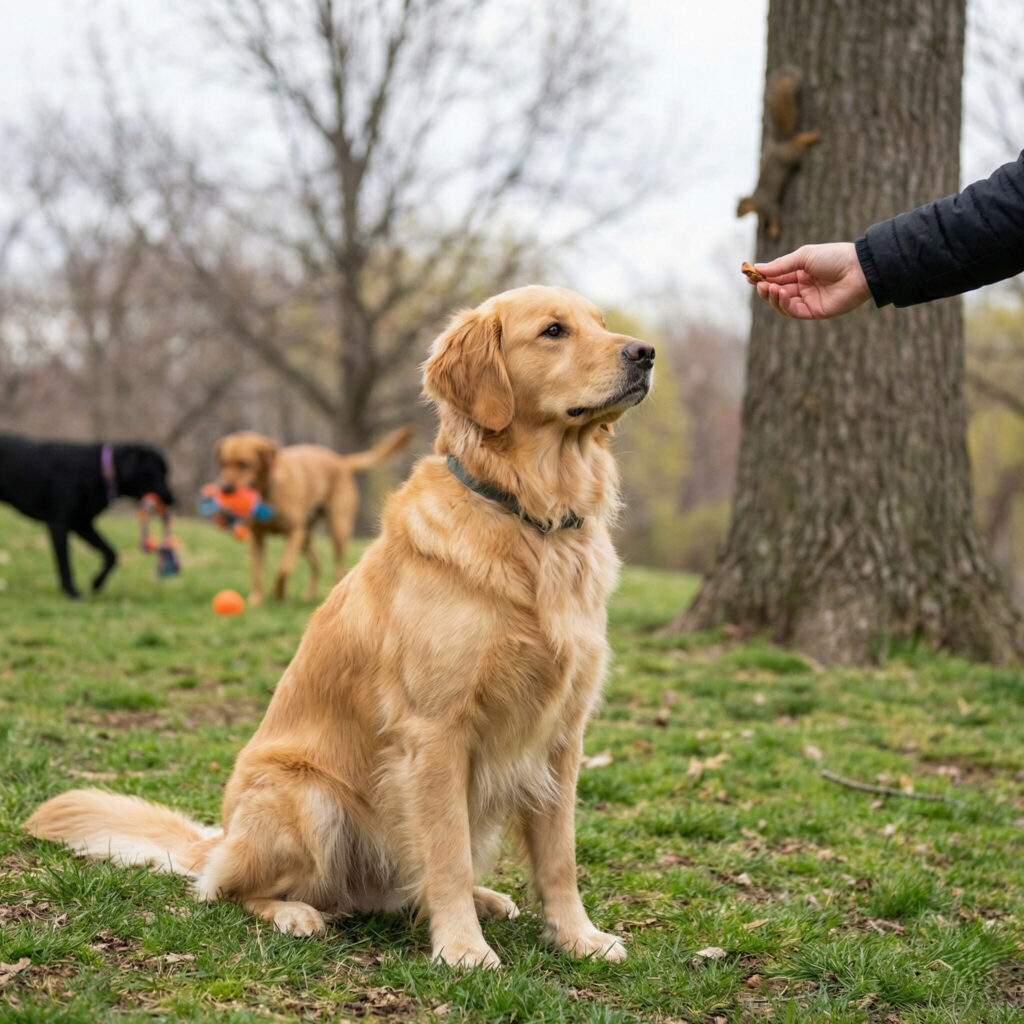
To build focus in an easily distracted dog, start training in a quiet, low-distraction environment using high-value treats or toys. Teach the “Look at Me” command to establish eye contact on cue. Gradually increase the difficulty by applying the “3 Ds” of dog training: Duration, Distance, and Distraction. Keep training sessions short, fun, and consistent to improve impulse control and engagement.
Summary Table
| Strategy | Purpose | Action Item |
| Manage Environment | Reduces competing motivators. | Start training indoors before moving outside. |
| High-Value Rewards | Increases motivation to work. | Use boiled chicken, cheese, or a favorite tug toy. |
| The “Look at Me” Cue | Teaches voluntary eye contact. | Reward the dog immediately when they look at your eyes. |
| The 3 Ds | Builds reliability. | Slowly increase Duration, Distance, and Distraction. |
| Premack Principle | Uses distractions as rewards. | Ask for a sit before allowing the dog to sniff a tree. |
| Short Sessions | Prevents burnout. | Train for 3-5 minutes, multiple times a day. |
How to Build Focus in Easily Distracted Dogs?
Before fixing the behavior, you must understand why it happens. A distracted dog is not necessarily a “bad” dog. Often, the world around them is simply more interesting than you are at that moment.
Dogs experience the world through their noses and ears much more intensely than humans do. A squirrel running up a tree, the scent of another dog, or a car backfiring can instantly break their concentration.
There are three main reasons for distraction:
- Overstimulation: The environment is too busy, and the dog cannot filter out the noise.
- Low Motivation: The reward you are offering (dry kibble) is less valuable than the distraction (a running rabbit).
- Lack of Clarity: The dog does not understand what you want them to do in that specific setting.
Read Also: Why Dogs React Differently on Leash
The Foundation: The “Look at Me” Command
The most critical tool in your training kit is the “Look at Me” or “Watch” command. This teaches your dog that looking at your face is a rewarding behavior. This is the “on-switch” for engagement.
Step-by-Step Guide
- Start Indoors: Begin in a boring room with no distractions.
- Lure the Eyes: Hold a treat near your dog’s nose, then slowly move it up to your eyes.
- Mark and Pay: As soon as the dog locks eyes with you, say “Yes!” (or click) and give the treat.
- Add the Cue: Once the dog is doing this reliably, say “Look” or “Watch” right before you move your hand.
- Fade the Lure: Eventually, stop holding the treat in your hand. Use the hand signal near your eyes, then reward from your pocket.
Understanding The 3 Ds of Dog Training
If your dog listens in the kitchen but ignores you at the park, you have skipped steps in the “3 Ds.” You must increase these variables separately, never all at once.
1. Duration
This is how long your dog can hold a command. If asking for eye contact, start with one second. Gradually build up to three seconds, then five, then ten. If the dog looks away, you moved too fast. Go back to a shorter time.
2. Distance
This refers to how far away you are from your dog, or how far your dog is from the distraction.
- From You: Can your dog focus on you if you are six feet away?
- From Distraction: It is easier for a dog to focus on you if the other dog is 50 feet away rather than 5 feet away.
3. Distraction
This is the level of competing interest in the environment.
- Low: Your living room.
- Medium: Your backyard.
- High: A busy park or pet store.
Entity Optimization Note: Professional trainers call this “generalizing behaviors.” Dogs do not automatically understand that “Sit” in the kitchen means “Sit” at the park. You must re-teach the command in the new environment, starting with lower criteria.
High-Value Rewards and Motivation
To compete with the environment, your payment must match the difficulty of the job.
If you are asking your dog to ignore a running squirrel (a very hard job), a piece of dry kibble (low pay) will not work. You need to upgrade your rewards.
Tiers of Rewards
- Low Value: Dry kibble, crunchy biscuits. Use these for easy tricks indoors.
- Medium Value: Soft commercial treats, cheese. Use these for backyard training.
- High Value: Boiled chicken, freeze-dried liver, hot dogs, steak. Use these for high-distraction environments like walks or parks.
- Toy Rewards: For high-drive dogs, a game of tug or a ball toss can be more valuable than food.
You must also consider the Rate of Reinforcement. This is how frequently you give treats. When a dog is struggling to focus, you should be treating them every 2-3 seconds to keep them engaged. As they get better, you can space out the treats.
Read Also: Training a Dog to Be Alone at Home
Engagement Games to Boost Focus
Training shouldn’t just be “Sit” and “Stay.” It should be fun. Engagement games teach the dog that you are the source of all fun things.
The Name Game
Say your dog’s name. As soon as they turn their head toward you, mark with “Yes!” and toss a treat on the floor. Repeat this rapidly. This builds a reflex where hearing their name means “check in with the human.”
Hand Targeting (Touch)
Teach your dog to touch their nose to your palm.
- Hold your palm out flat.
- When the dog sniffs it, say “Yes!” and treat.
- Add the word “Touch.”
- Move your hand to different positions. This is excellent for nervous dogs because it gives them a simple, easy task to focus on when they are overwhelmed.
The “Find It” Game
If your dog is getting locked onto a distraction (staring hard at another dog), toss a handful of treats into the grass and say, “Find it!” This breaks their eye contact and engages their nose. Sniffing is naturally calming for dogs and helps lower their arousal levels.
Managing Thresholds and Environment
A “threshold” is the distance at which your dog can notice a distraction but still listen to you.
- Under Threshold: The dog sees the distraction but can still eat treats and look at you. This is the “Learning Zone.”
- Over Threshold: The dog is barking, lunging, or staring fixedly. They will not eat treats. They cannot learn in this state.
If your dog goes over the threshold, you are too close. Do not try to command them to sit. Instead, create distance. Turn around and walk away until the dog relaxes.
The “U-Turn” Strategy
If you see a major distraction ahead that you know your dog can’t handle:
- Say a happy cue like “Let’s Go!”
- Immediately turn 180 degrees and jog away playfully.
- Reward heavily when the dog follows you. This prevents the reaction before it starts.
The Premack Principle (Granny’s Rule)
The Premack Principle states that a high-probability behavior (sniffing a tree, chasing a squirrel) can be used to reward a low-probability behavior (looking at you).
Think of it as “Eat your vegetables, then you get dessert.”
Example:
Your dog wants to sniff a fire hydrant.
- Stop walking before you reach the hydrant.
- Wait for your dog to look at you or ask for a “Sit.”
- As soon as they do, say “Go sniff!” and release them to the hydrant.
The reward wasn’t a treat; the reward was the environment. This teaches the dog that working with you unlocks the environment.
Read Also: How to Stop Jumping on Guests
Common Mistakes to Avoid
Repeating Commands
Do not say “Sit, sit, sit, sit.” If you say it five times, you have taught your dog that the command is “Sit-sit-sit-sit-sit,” or that they don’t have to listen the first time. Say it once. If they don’t do it, help them or wait.
Poisoning the Cue
If you use the word “Come” and then immediately give the dog a bath or clip their nails, you have poisoned the cue. The dog learns that “Come” leads to bad things. Always follow a recall with a massive reward.
Training for Too Long
Dogs burn out quickly. Training sessions should be 3 to 5 minutes long. Always end on a high note where the dog was successful, not when they (or you) are frustrated.
Conclusion
Building focus in an easily distracted dog is a marathon, not a sprint. It requires patience, consistency, and a clear understanding of what motivates your dog.
Remember to start in a quiet environment and master the “Look at Me” command. Use high-value rewards that can compete with the world around you, and pay close attention to your dog’s thresholds. If they are failing, make the task easier.
By turning yourself into the most interesting thing in the environment through engagement games and positive reinforcement, your dog will eventually choose you over the squirrel. Keep it fun, keep it short, and celebrate the small wins.