
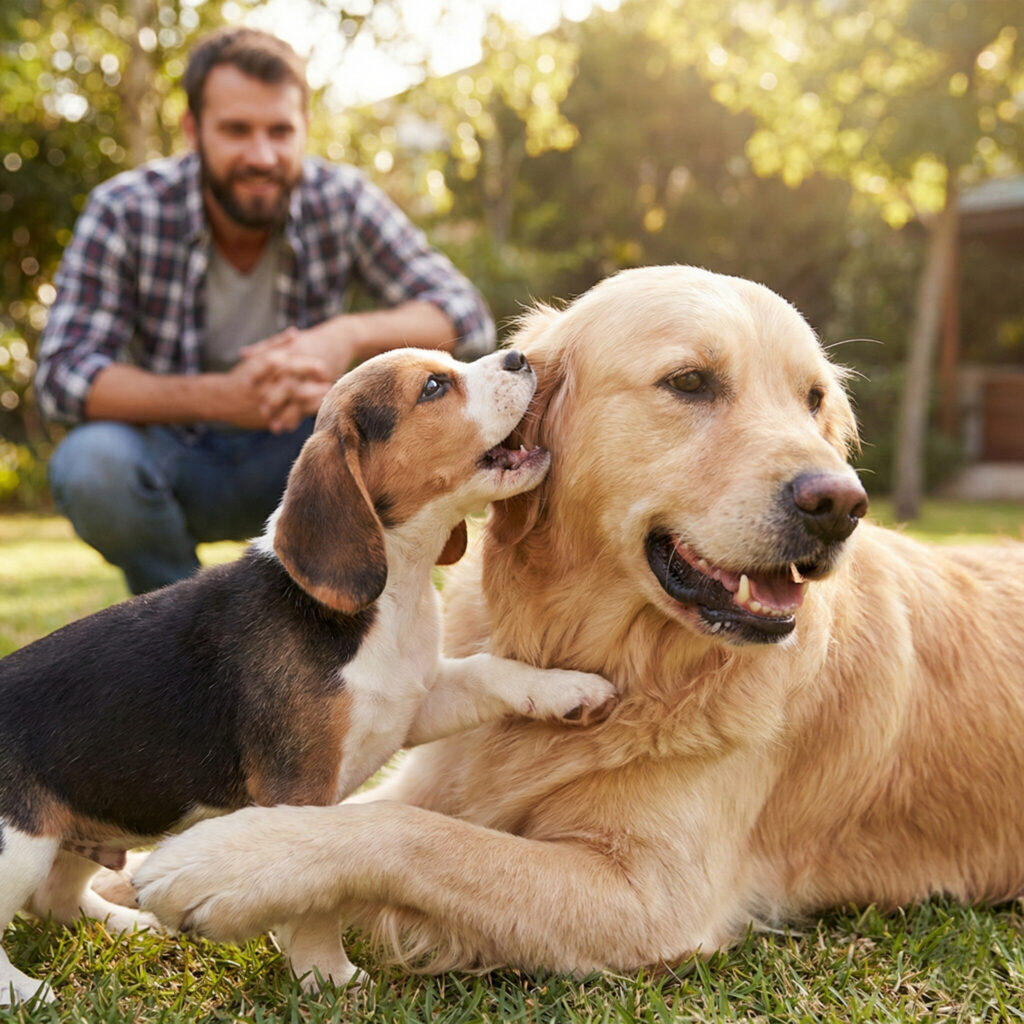
Puppies learn social boundaries primarily through interaction with their mother and littermates between 3 and 14 weeks of age. During play, they develop bite inhibition when siblings yelp or stop playing after a hard bite. The mother dog corrects rude behavior with growls or snaps. Humans reinforce these lessons using positive reinforcement, consistency, and redirection to teach appropriate manners and impulse control.
Summary Table
| Developmental Stage | Key Learning Focus | Who Teaches It? | Key Method |
| 3–8 Weeks | Bite inhibition, body language basics | Mother & Littermates | Play biting, yelping, maternal correction |
| 8–12 Weeks | Human interaction, household rules | Human Owners | Positive reinforcement, redirection, routine |
| 12–16 Weeks | Exploring the world, meeting new dogs | New Environments | Exposure to vaccinated dogs, puppy classes |
| 4–6 Months | Testing boundaries (adolescence) | Owners & Adult Dogs | Consistent training, “time-outs” for rude play |
How Puppies Learn Social Boundaries
Bringing a new puppy home is exciting, but it comes with the challenge of turning a bundle of energy into a polite family member. A crucial part of a dog’s development is learning social boundaries.
These are the unwritten rules of dog society (and human society) that dictate how a dog should act. They include knowing how hard to bite during play, respecting personal space, and understanding when to calm down.
Puppies are not born knowing these rules. They are born with instincts, but social manners are learned behaviors.
This learning process happens in stages, involving their biological family first and their human family second. Understanding this process helps you raise a confident, well-adjusted dog.
Read Also: Why Do Puppies Cry at Night?
The Critical Socialization Window
The most important time for a puppy to learn boundaries is during the socialization period, which generally runs from 3 weeks to about 14 weeks of age. During this window, a puppy’s brain is like a sponge. They are incredibly receptive to new experiences, and the lessons they learn here often stick for life.
If a puppy misses out on learning boundaries during this time, they may develop behavioral issues later, such as fear aggression, separation anxiety, or an inability to read social cues from other dogs.
Stage 1: Learning from the Litter (3 to 8 Weeks)
Before you ever bring your puppy home, their education has already begun. The first teachers are the mother dog (dam) and the siblings (littermates). This is why it is so important not to separate a puppy from its litter before 8 weeks of age.
Bite Inhibition
One of the most vital skills a puppy learns from their siblings is bite inhibition. This is the ability to control the force of their jaws.
- The Scenario: Puppies play by wrestling and biting each other. Their teeth are needle-sharp.
- The Reaction: If Puppy A bites Puppy B too hard, Puppy B will yelp loudly and stop playing.
- The Lesson: Puppy A learns that biting too hard causes the fun to stop. To keep the game going, they must bite gently.
If a puppy is taken away from their litter too early, they often miss this lesson. This results in a dog that has a “hard mouth” and doesn’t understand that their teeth hurt human skin.
The Mother’s Discipline
The mother dog is strictly fair but firm. She does not tolerate rude behavior. If a puppy bites her too hard, harasses her while she is resting, or tries to nurse when she is weaning them, she will correct them.
- Low-level correction: She may stand up and walk away.
- Mid-level correction: She may give a low growl or a curl of the lip.
- High-level correction: She may air-snap or pin the puppy down gently with her muzzle.
This teaches the puppy to read canine body language. They learn that a stiff posture or a growl means “back off.” This respect for signals is the foundation of social boundaries.
Stage 2: The Human Role (8 Weeks and Beyond)
Once the puppy enters your home, you take over the role of the teacher. You are now responsible for teaching the puppy how to navigate the human world. Puppies do not understand English, and they do not understand human morals. They only understand consequences—what works and what doesn’t.
Teaching “The Off Switch”
Puppies often lack an “off switch.” They can go from calm to frantic in seconds. You must teach them that calm behavior gets rewarded, while frantic, pushy behavior gets ignored.
- Ignore the bad: When the puppy jumps on you or barks for attention, turn your back. Do not look at them, touch them, or speak to them.
- Reward the good: The moment the puppy keeps all four paws on the floor or sits, give them a treat and praise.
- Be consistent: Everyone in the house must follow the same rules. If Dad lets the puppy jump but Mom doesn’t, the puppy will be confused, and boundaries will not form.
Managing Puppy Biting (Mouthing)
Even if a puppy learned bite inhibition from their litter, they will still test their teeth on you. Human skin is much thinner than dog fur, so you need to refine their bite inhibition further.
- The “Ouch” Method: When the puppy bites your hand, make a high-pitched “Ouch!” or yelp sound, just like a littermate would.
- The Freeze: Immediately go limp. Do not pull your hand away quickly, as this triggers their prey drive to chase.
- The Restart: When the puppy backs off, praise them and offer a toy instead.
If the puppy continues to bite hard despite the yelp, use a “time-out.” Place the puppy in a safe, boring area (like a playpen) for 30 seconds to show that biting leads to a loss of social interaction.
Read Also: What to Expect During a Puppy’s First 90 Days
Stage 3: Interaction with Other Dogs
Just because a puppy lived with littermates doesn’t mean they know how to greet every dog. Different breeds have different play styles. A Boxer might like to box with their paws, while a Border Collie might try to herd.
Reading Body Language
Puppies learn boundaries by interacting with vaccinated, well-behaved adult dogs. An adult dog will teach a puppy manners faster than any human can.
- The Play Bow: Front elbows down, rear end up. This means “Everything I do next is just for fun.”
- The Cut-Off Signal: If an adult dog turns their head away, yawns, or freezes, they are telling the puppy to stop.
- Correction: If the puppy ignores these signs, the adult dog might growl or snap. This is normal communication. As long as no blood is drawn and the puppy respects the correction, this is healthy social learning.
Puppy Classes
Enroll your puppy in a socialization class. These classes are supervised by trainers who can identify good play versus bullying.
- Good Play: Bouncing, taking turns, chasing each other, and momentary pauses.
- Bad Play: One dog constantly pinning the other, biting that causes yelping without release, or one dog trying to hide. In these classes, puppies learn that they are not the center of the universe and must focus on their owners even when other dogs are around.
Understanding Impulse Control
Social boundaries are essentially about impulse control. It is the ability to see something they want (a treat, a toy, a person) and wait patiently rather than grabbing it.
The “Wait” Command
Teaching “wait” is a great way to build mental boundaries.
- Put a food bowl on the floor.
- If the puppy dives for it, lift it up.
- Lower it again. If they wait, lower it further.
- Once the bowl is on the floor and the puppy is still waiting, say “Okay!” and let them eat.
This teaches the puppy that they do not own everything in the environment and must look to you for permission. This respect for resources is a key social boundary.
Read Also: Puppy Care & Development
Common Mistakes Owners Make
Even with good intentions, owners can accidentally ruin a puppy’s understanding of boundaries. Avoiding these pitfalls is essential for puppy training success.
1. Encouraging Rough Play
Wrestling with your puppy using your bare hands teaches them that hands are toys. This is cute when they are 8 weeks old, but dangerous when they are adult dogs. Always use a toy to play tug or fetch. Keep your hands for petting and handling only.
2. Inconsistency
If you let the puppy on the couch on Friday but yell at it for it on Monday, the puppy cannot learn the boundary. Boundaries must be black and white. If a behavior is not allowed, it is never allowed.
3. Using Punishment
Yelling, hitting, or “rubbing their nose in it” does not teach boundaries. It creates fear. A fearful dog does not learn well and may become defensive. Constructive discipline means removing rewards (attention/treats), not adding pain.
Adolescence: The Regression Phase
Around 5 to 6 months of age, puppies enter adolescence. Their hormones change, and they become more independent. You might feel like your puppy has forgotten every boundary they ever learned.
This is a testing phase. They are checking to see if the boundaries are still solid.
- Stay the Course: Do not give up on training. Be even more consistent.
- Reinforce Basics: Go back to basic obedience like “sit,” “stay,” and “leave it.”
- Exercise: An adolescent dog has more energy. A tired dog is a well-behaved dog. Ensure they get enough physical and mental stimulation.
Signs Your Puppy Has Learned Boundaries
How do you know if your training is working? Look for these “green flags” in your dog’s behavior:
- Soft Mouth: When playing, they are careful not to put their teeth on skin.
- Looking for Permission: They look at you before chasing a squirrel or greeting a stranger.
- Responding to Corrections: If another dog growls, your puppy backs off immediately rather than fighting back.
- Settling Down: They can relax in the house even when not being actively entertained.
Conclusion
Puppies learn social boundaries through a mix of natural instinct, interaction with other dogs, and consistent guidance from their human owners. It is a journey that starts in the whelping box with their mother and continues well into their adult life.
The key to success is patience. You are teaching a different species how to live in your world. By prioritizing socialization, respecting the critical window, and using positive reinforcement, you help your puppy understand their limits. This creates a relationship built on trust and respect, resulting in a dog that is a joy to be around.