
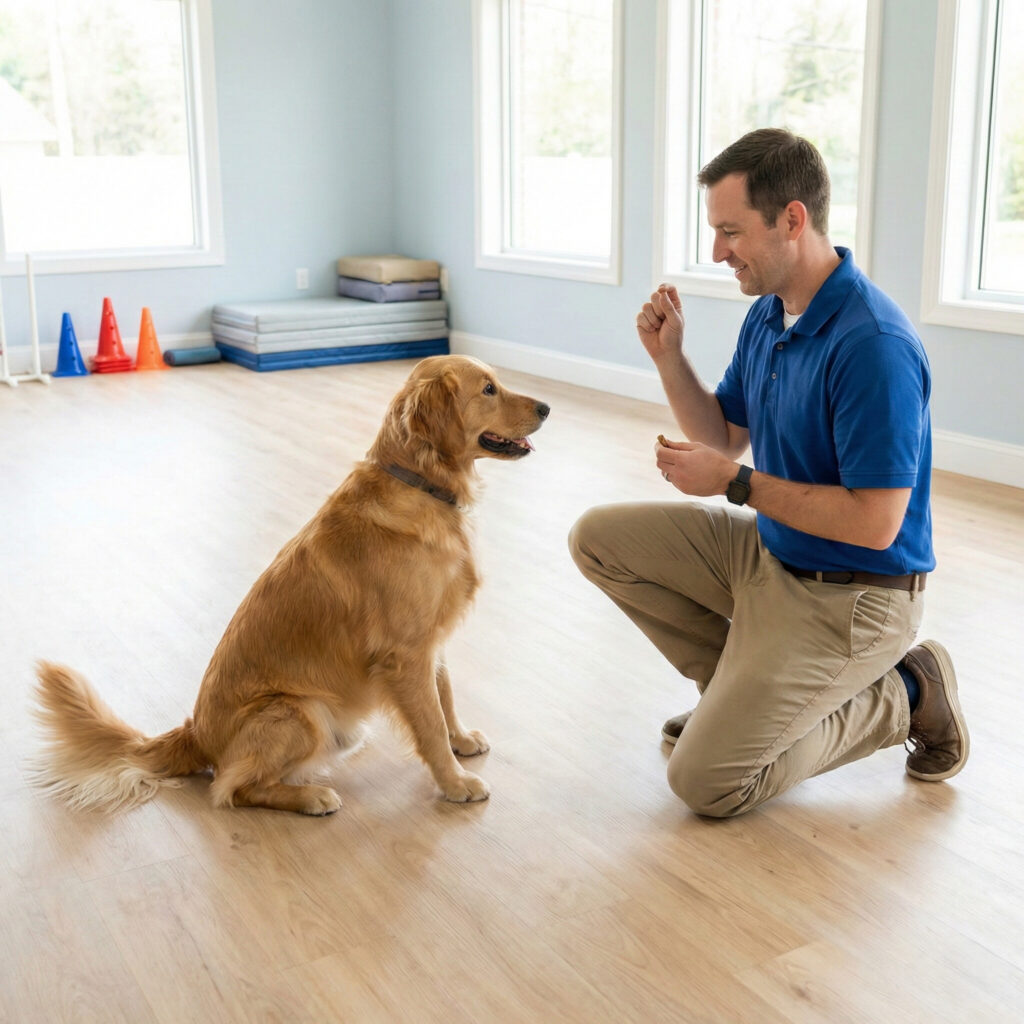
A dog training session should typically last between 5 to 15 minutes. For young puppies (under 6 months), keep sessions strictly to 3–5 minutes to match their short attention spans. Adult dogs can handle 10–15 minutes. It is more effective to have multiple short sessions throughout the day, ideally three to five, rather than one long, exhausting session. Always end on a positive note while the dog is still engaged.
Summary Table: Dog Training Session Duration
| Factor | Recommended Duration | Frequency Per Day | Key Focus |
| Young Puppies (8–16 weeks) | 2–5 minutes | 3–5 sessions | Basic engagement, luring, name recognition |
| Adolescent Dogs (6–18 months) | 5–10 minutes | 2–4 sessions | Impulse control, reinforcing basics, recall |
| Adult Dogs (1.5+ years) | 10–15 minutes | 2–3 sessions | Advanced skills, trick training, proofing behaviors |
| Complex/New Tasks | 3–5 minutes | Frequent micro-sessions | Shaping new behaviors, high mental effort tasks |
| Review/Known Tasks | 10–20 minutes | 1–2 sessions | Refining skills, adding distance/distraction |
How Long Should a Dog Training Session Last?
One of the most common questions new dog owners ask is exactly how much time they need to dedicate to training each day. There is a misconception that you need to spend an hour every evening drilling commands like a sergeant. This approach often leads to frustration for both the human and the dog.
The truth is that dog training is not about endurance; it is about quality and consistency. Dogs are cognitive learners with limits on their mental energy. Pushing past those limits is counterproductive. This guide covers exactly how to time your sessions for maximum retention, how to spot when your dog has had enough, and how to structure the perfect training routine.
Read Also: Dog Training & Behavior Management
The Goldilocks Rule: Short and Sweet
For the vast majority of dogs, the ideal training session is short, frequent, and positive.
The scientific consensus among animal behaviorists is that 5 to 15 minutes is the sweet spot. This duration allows the dog to get into a rhythm without experiencing mental fatigue or “brain burn.”
Think of dog training like learning a new language. If you tried to memorize vocabulary for two hours straight, you would likely forget half of it and feel exhausted. If you studied for 10 minutes, took a break, and came back later, your retention would be significantly higher. Dogs learn the same way.
Why Shorter Sessions Work Better
- Higher Motivation: When sessions are short, the rewards (treats, toys, praise) come fast and frequent. This keeps the dog highly motivated.
- Better Retention: Latent learning—the brain’s ability to process information during rest—happens when the dog sleeps or relaxes after a session. Frequent breaks allow this processing to happen.
- Reduced Frustration: Long sessions often lead to mistakes. Mistakes lead to frustration. Ending the session while the dog is succeeding builds confidence.
Training Duration by Age
Age is the single biggest factor in determining how long you can train. A puppy’s brain is physically different from an adult dog’s brain. They lack the impulse control and focus required for sustained work.
1. Puppies (8 Weeks to 6 Months)
Duration: 2 to 5 minutes
Frequency: 4 to 6 times per day
Puppies are easily distracted. A leaf blowing across the grass or a noise in the next room can completely break their focus. For puppies, “training” is happening 24/7 because they are learning how to live in your world. Structured sessions should be micro-sessions.
- Goal: Capture the behavior, reward it, and stop.
- Example: Do three repetitions of “sit” before breakfast. Do two minutes of leash walking in the living room before a nap.
- Warning: If your puppy starts biting the leash, wandering off, or scratching, you have already trained too long.
2. Adolescents (6 Months to 18 Months)
Duration: 5 to 10 minutes
Frequency: 3 to 4 times per day
This is often called the “teenage phase.” Dogs in this age bracket have more stamina than puppies, but they often regress in behavior due to hormonal changes and brain development. They may seem to “forget” commands they knew perfectly last week.
- Goal: Consistency and proofing (practicing known commands in new environments).
- Strategy: Keep sessions fun and unpredictable to hold their attention. If they are being stubborn, shorten the session and go back to basics.
3. Adult and Senior Dogs
Duration: 10 to 15 minutes (up to 20 for working breeds)
Frequency: 2 to 3 times per day
Adult dogs have fully developed attention spans. They can handle more complex chains of behaviors (like “go to your bed and stay”). However, even adult dogs rarely benefit from sessions longer than 20 minutes unless they are working breeds (like Border Collies or German Shepherds) specifically conditioned for endurance work.
Read Also: When Is Panting Normal vs Dangerous?
Signs Your Session Is Too Long
Dogs cannot tell us when they are tired, but their body language screams it. The biggest mistake owners make is ignoring these signals and pushing for “just one more try.” This is usually when training falls apart.
If you see these signs, end the session immediately (throw a “party” or toss a handful of treats on the ground to end on a high note):
Displacement Behaviors
These are normal behaviors performed out of context, indicating stress or conflict.
- Sneezing: Repeated sneezing when not sick.
- Scratching: Suddenly stopping to scratch an ear or flank.
- Yawning: A wide yawn when not sleepy.
- Lip Licking: Quick flicks of the tongue over the nose.
- Sniffing the Ground: Suddenly becoming very interested in a spot of grass to avoid eye contact or the command.
Disengagement
- Walking Away: The dog simply leaves the training area.
- Slower Responses: The dog knows the command “sit,” but does it in slow motion.
- Barking/Nipping: Frustration barking or jumping up at you.
The “Micro-Session” Technique
One highly effective method for busy owners is the concept of “Micro-Sessions.” Instead of carving out a 15-minute block, you integrate training into daily life. This is often more effective for generalization (helping the dog understand that “sit” means “sit” everywhere, not just in the living room).
Examples of Micro-Sessions
- The Doorway Wait: Ask for a “sit-stay” every time you open the back door to let them out. (Duration: 30 seconds).
- The Mealtime Protocol: Ask for a trick or a sequence of commands before putting the food bowl down. (Duration: 1 minute).
- Commercial Breaks: Do a quick training set during TV commercials. (Duration: 2 minutes).
- Walk Pauses: Stop randomly during a walk and ask for eye contact or a “touch” to the hand. (Duration: 10 seconds).
This approach builds a dog who is always listening, rather than a dog who only listens when you are wearing your “training treat pouch.”
Structuring the Perfect 15-Minute Session
If you are doing a dedicated 15-minute session, do not just drill the same command over and over. Structure it like a workout class.
Phase 1: The Warm-Up (2–3 Minutes)
Start with easy wins. Ask for commands the dog knows perfectly and enjoys doing. This builds confidence and gets the dog in a “working mode.”
- Hand touches (nose boops).
- Simple sits or downs.
- “Spin” or “shake.”
Phase 2: The Challenge (5–8 Minutes)
This is the meat of the session where you work on new concepts or difficult tasks.
- Teaching a new trick.
- Increasing the duration of a “stay.”
- Working on loose-leash walking.
- Note: If the dog fails three times in a row, make the task easier immediately. Do not keep failing.
Phase 3: The Cool-Down (2–3 Minutes)
End with something fun and low-pressure. Never end a session on a failure or a difficult repetition.
- Play a game of tug.
- Do a “find it” game (tossing a treat in the grass).
- A gentle massage or cuddle time if the dog enjoys it.
Read Also: How to Safely Lift and Carry a Dog
Factors That Influence Attention Span
Not all 15-minute sessions are created equal. Several external variables can drain your dog’s battery faster than usual.
1. Distractions
Training in your quiet living room is “low cost” for your dog’s brain. Training at a busy park with squirrels, other dogs, and traffic is “high cost.”
- Rule: As distractions increase, session duration must decrease. You might get 15 minutes of focus at home, but only 3 minutes at the park.
2. Difficulty of the Task
Learning something entirely new takes much more mental energy than practicing something known.
- Shaping Behaviors: If you are shaping a complex behavior (like opening a door or retrieving a specific item), keep sessions very short (3–5 minutes) because the dog has to think hard to solve the puzzle.
3. The Dog’s Health and Energy Levels
A tired dog cannot learn effectively. Avoid training immediately after a long run or vigorous play session, as the dog will be physically exhausted. Conversely, a dog bursting with pent-up energy might need a 5-minute game of fetch before training to get the “zoomies” out so they can focus.
Common Mistakes Regarding Duration
The “Just One More” Trap
You are teaching your dog to “shake.” They finally do it perfectly! You are excited. You want to see it again. You ask for it again. They do it. You ask a third time. They get bored and walk away.
- The Fix: Quit while you are ahead. If the dog has a breakthrough moment, jackpot reward them (give them 5–10 treats at once) and end the session immediately. Let that success sink in.
Training When You Are Frustrated
Dogs are masters at reading human body language. If you have had a long day at work and you are irritable, your dog will sense it. Your tone will be sharper, and your patience will be thinner.
- The Fix: Skip the session. It is better to skip a day of training than to have a negative session that damages your bond.
Inconsistency
Training for one hour on Sunday and zero minutes the rest of the week is ineffective.
- The Fix: Consistency beats intensity. Five minutes every day is infinitely better than one hour once a week.
Conclusion
The goal of dog training is not to clock hours; it is to build communication. By respecting your dog’s cognitive limits and keeping sessions short, fun, and frequent, you will see faster progress and a happier dog.
If you find your dog checking out, sniffing the grass, or looking confused, look at the clock. You have likely gone over the limit. Reset, shorten the time tomorrow, and remember that training should always be the best part of your dog’s day.