
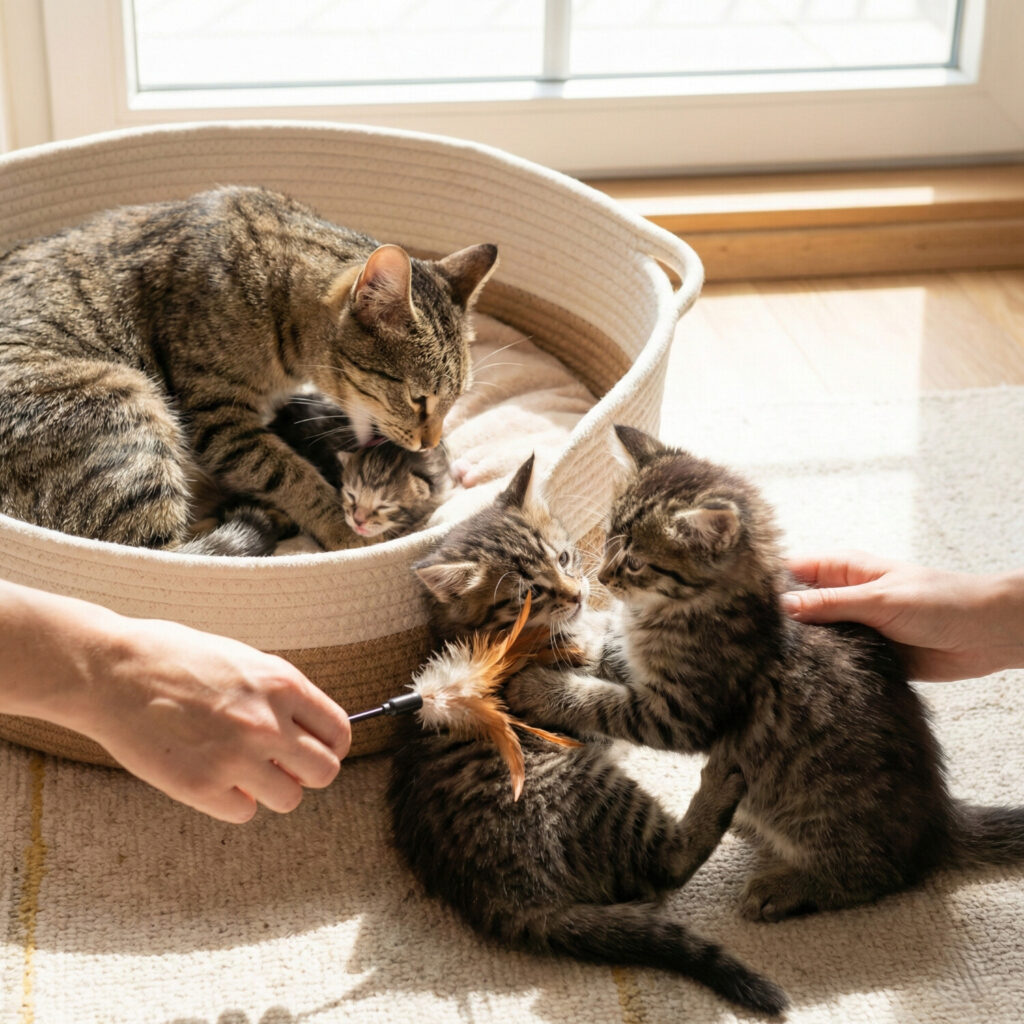
Kittens learn social skills primarily during a critical socialization window between 2 and 7 weeks of age. They acquire these skills through three main channels: observation and discipline from their mother (the queen), play fighting and interaction with littermates which teaches bite inhibition, and positive handling by humans to build trust.
Summary Table: Key Milestones in Kitten Socialization
| Age Range | Developmental Stage | Key Social Skill Learned | Primary Teacher |
| 0 to 2 Weeks | Neonatal | Scent recognition and tactile comfort | Mother (Queen) |
| 2 to 7 Weeks | Primary Socialization | Play fighting, bite inhibition, and human trust | Littermates & Humans |
| 7 to 14 Weeks | Secondary Socialization | Object play, predatory skills, and confidence | Environment & Humans |
| 3 to 6 Months | Ranking & Testing | Social boundaries and hierarchy testing | Humans & Other Pets |
| 6 to 18 Months | Adolescence | Reinforcing learned behaviors or developing fears | Routine & Exposure |
The Science of How Kittens Learn Social Skills
Raising a kitten is a rewarding experience. However, many owners are surprised to learn that a cat’s personality is not entirely random. While genetics play a role, a massive portion of a cat’s behavior is shaped during a very short window of time.
This guide explores exactly how kittens transform from helpless infants into socially confident adult cats. We will look at the biology of their learning, the specific roles played by their family members, and what happens when this process goes wrong.
Read Also: How to Stop Door Dashing Behavior in Cats
The Critical Socialization Period
The most important concept to understand is the sensitive period of socialization. For kittens, this window opens at 2 weeks of age and begins to close around 7 weeks of age. This is much shorter than the socialization window for puppies.
During these few weeks, a kitten’s brain is incredibly elastic. It is ready to accept new experiences as normal and safe. If a kitten meets different types of people, hears loud noises, or meets other animals during this time, they will likely accept these things for life. If they do not encounter these things until after 7 weeks, they may react with fear or aggression.
This period is biological. The brain is physically developing the pathways that process fear and social bonding. Once the window closes, it becomes much harder to change a cat’s natural reaction to new things.
This is why feral kittens rescued after 8 weeks of age are often very difficult to tame, while those rescued at 4 weeks can become cuddly house cats.
The Role of the Mother Cat (The Queen)
The mother cat is the first and most influential teacher. Her job goes beyond providing milk. She models appropriate behavior and provides a sense of safety that allows kittens to explore.
Observation Learning
Kittens are master observers. They watch how their mother reacts to the world. If a human walks into the room and the mother greets them calmly, the kittens learn that humans are safe. If the mother hisses or hides, the kittens learn that humans are dangerous. This is called social referencing. The emotional state of the mother is transferred to the kittens.
Calming and Grooming
The mother uses grooming to bond with her kittens and to calm them down. This tactile stimulation helps the kittens develop a tolerance for touch. It stimulates their nervous system and helps them grow.
Kittens who are groomed often by their mothers are generally more resilient to stress later in life.
Discipline
The queen also teaches boundaries. If a kitten is too rough while nursing or annoys the mother, she will correct them. She might stand up and walk away, ending the interaction. In some cases, she might give a soft swat or a growl.
This teaches the kitten frustration tolerance. They learn that they cannot always get what they want immediately and must respect the space of others.
Learning from Littermates
While the mother provides safety, littermates provide the testing ground. Interaction with brothers and sisters is vital for learning physical limits and communication.
Bite Inhibition
This is perhaps the most critical skill a kitten learns from their siblings. When kittens are 3 to 4 weeks old, they begin to play fight. They wrestle, pounce, and bite each other.
At this age, they do not know their own strength. A kitten might bite a sibling too hard. When this happens, the sibling will cry out in pain and stop playing. The game ends. The biting kitten learns a valuable lesson: “If I bite too hard, the fun stops.”
Over time, they learn to control the pressure of their jaws. They learn to use a “soft mouth” during play. Kittens who are separated from their litter too early, often known as singletons, often miss this lesson.
They may grow up to be cats that bite their owners hard because they never learned that teeth cause pain.
Social Cues and Body Language
Siblings also teach each other how to read signals. If one kitten arches their back and fluffs their tail, the other kitten learns to back off. They learn that ears pinned back means “I am angry” or “I am scared.” By constantly interacting, they become fluent in the language of “cat.”
The Human Element
For a kitten to become a good pet, they must learn that humans are friends, not predators. This does not happen automatically. It requires active effort during the 2 to 7 week window.
Positive Handling
Kittens should be held gently by different people. This includes men, women, and supervised children. The handling should be short and positive. If a kitten is held for a few minutes and then given a treat or a toy, they associate being picked up with good things.
Owners should touch the kitten’s paws, ears, and mouth. This prepares them for future veterinary visits and nail trims. If a cat only experiences these touches when they are in pain at the vet, they will become defensive. If they experience them daily with rewards as a kitten, they will remain calm.
Exposure to Sounds and Smells
A household is a noisy place. Vacuum cleaners, washing machines, doorbells, and televisions can be terrifying to an animal that relies on hunting instincts.
Socialization involves exposing kittens to these sounds at a low volume and gradually increasing it. If a kitten hears a vacuum while they are eating or playing, they learn to ignore it.
We call this habituation. The goal is for the kitten to realize that these noises are just background static and not a threat to their safety.
The Singleton Kitten Challenge
A “singleton” is a kitten that is the only survivor of a litter or was removed from the mother and siblings very early. These kittens face significant social hurdles.
Without siblings to bite them back, they often develop “Single Kitten Syndrome.” They may be aggressive during play because they lack bite inhibition. They may also be overly attached to their owner or, conversely, unable to understand social boundaries.
To help a singleton learn social skills, humans must take on the role of the littermates. This does not mean biting the kitten. It means stopping play immediately if the kitten uses teeth or claws.
You can use a stuffed animal to wrestle with the kitten so they can vent their energy on a toy rather than your hands. If possible, fostering a second kitten of the same age can provide the necessary peer interaction.
Read Also: Why Do Cats Vocalize Before Using the Litter Box?
The Importance of Play
Play is not just burning energy. It is a rehearsal for adult life.
Predatory Play
Kittens practice hunting sequences: stalk, chase, pounce, and bite. This is instinctive. Toys that mimic prey, like feather wands or laser pointers, allow them to exercise these instincts safely. It is important to let the kitten “catch” the toy eventually to prevent frustration.
Social Play
This involves wrestling and chasing other cats. It reinforces social bonds. Mutual grooming often follows a play session. This cements the relationship between the two cats and reduces tension in the group.
Socialization Beyond 8 Weeks
While the primary window closes at 7 weeks, learning continues. The juvenile period (adolescence) lasts from roughly 6 months to 18 months.
During this time, a cat may test boundaries. They might try to jump on counters they were previously forbidden from. They might challenge other pets in the house for status. Continued reinforcement is necessary.
If you stop handling your cat or stop introducing them to new things after 8 weeks, they can regress. They may become shy or fearful again. “Use it or lose it” applies to social skills in cats.
Common Mistakes in Socialization
Even well-meaning owners can make errors that hinder a kitten’s social development.
- Using Hands as Toys: It is cute when a tiny kitten attacks your fingers. It is painful and dangerous when a 10-pound adult cat does it. Never teach a kitten that human skin is a toy. Always use a wand or a plush toy.
- Overwhelming the Kitten: Flooding a kitten with too many new people or scary situations at once can cause “learned helplessness” or extreme fear. Introductions should be gradual.
- Punishment: Yelling or hitting a kitten does not teach them social skills. It only teaches them to fear you. Cats do not understand punishment the way humans do. They respond much better to redirection (showing them what to do instead) and positive reinforcement (rewards).
Introducing a Kitten to Other Pets
Social skills are put to the test when a new kitten meets an existing resident dog or cat. This introduction must be managed carefully.
Scent First
Animals communicate heavily through smell. Before they see each other, they should smell each other. You can swap their bedding or rub a cloth on the kitten’s cheek and let the resident pet smell it. This introduces the “idea” of the new kitten without the threat of a physical presence.
Visual Access
Use a baby gate or a carrier to let them see each other without being able to touch. This prevents fights and allows them to observe body language from a safe distance.
Controlled Meetings
Face-to-face meetings should be short and involve food. Feeding them on opposite sides of a closed door or a gate creates a positive association. “When the other animal is near, I get delicious food.”
The Impact of Genetics
It is important to acknowledge that nature plays a role alongside nurture. Some cat breeds are naturally more social and outgoing, such as the Siamese or Burmese. Others may be more reserved.
Furthermore, the father’s personality (the tom) can influence the kittens, even if he is never present. Studies suggest that bold fathers tend to produce bold kittens. If a kitten is naturally shy due to genetics, they can still learn social skills, but they may need more patience and a quieter environment than a genetically bold kitten.
Summary of Environmental Enrichment
A socially skilled cat is a confident cat. Confidence comes from owning their territory. Environmental enrichment helps kittens feel secure.
- Vertical Space: Cats feel safer when they are high up. Cat trees and shelves allow them to observe social situations from a distance before choosing to join in.
- Hiding Spots: Every room should have a place where the kitten can retreat if they feel overwhelmed. A box or a tunnel works well.
- Scratching Posts: Scratching is a territorial marker. It leaves a visual mark and a scent mark. Having appropriate places to scratch allows a cat to signal their presence socially without destroying furniture.
Conclusion
Kittens learn social skills through a complex mix of biological timing, observation, and interaction. The window between 2 and 7 weeks is the golden opportunity to shape a cat’s future personality.
During this time, the lessons taught by the mother regarding safety, the lessons taught by siblings regarding bite inhibition, and the lessons taught by humans regarding trust all combine to create a well-adjusted pet.
Understanding these mechanisms allows us to be better owners. We can forgive a singleton for being rough and help them learn control. We can read a flicking tail and give a cat space. By respecting their natural development and communicating in ways they understand, we ensure that our kittens grow into happy, social companions.