
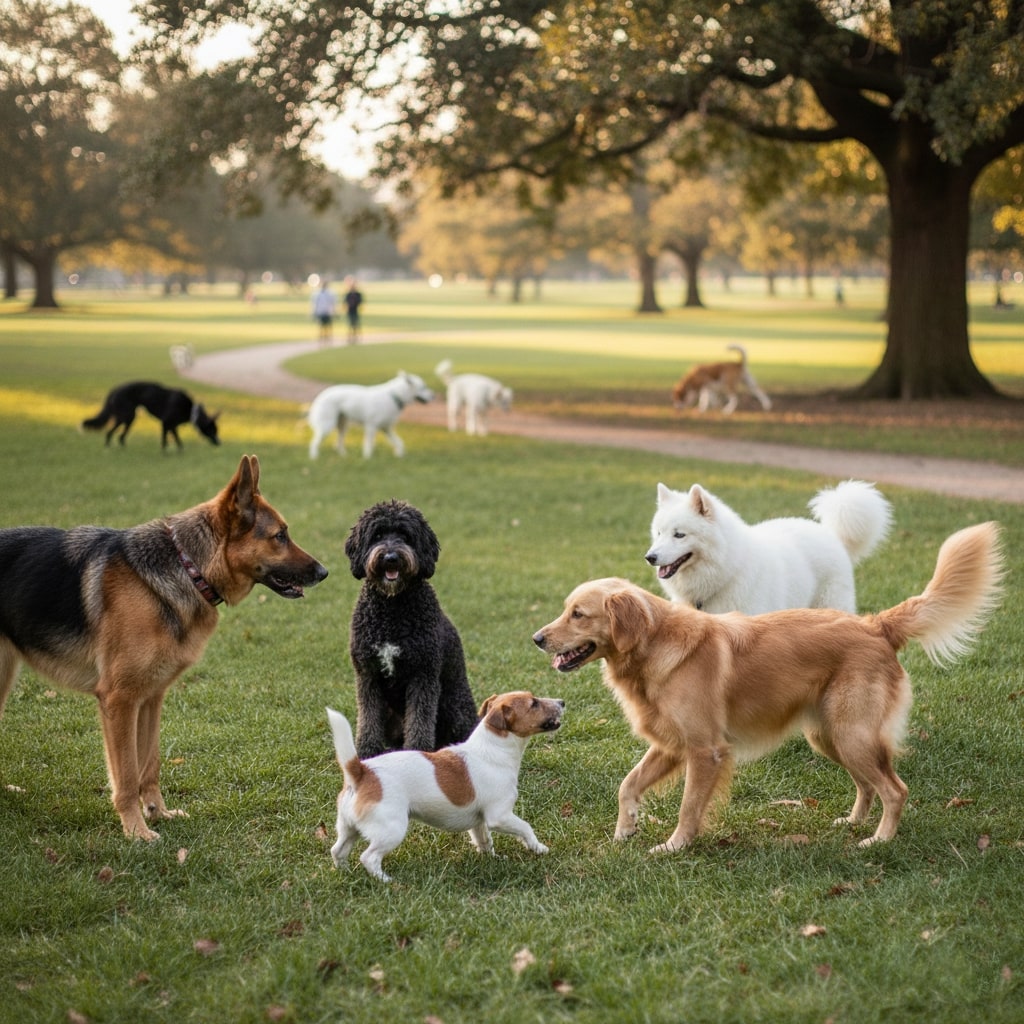
Dogs communicate with other dogs through a complex system of body language, vocalizations, scent, and touch. Their primary method is non-verbal, relying heavily on body posture, tail position, and facial expressions to convey emotions like aggression, fear, submission, or playfulness. Scents form a “chemical profile” that tells other dogs about their gender, health, and status, while vocal sounds like barks, growls, and whines add immediate context to their physical signals.
Summary Table: Dogs Communication with Other Dogs
| Communication Type | Signal | Meaning |
| Tail | High and stiff | Alert, dominant, or aggressive |
| Tail | Low or tucked | Fearful, submissive, or anxious |
| Tail | Broad, loose wag | Friendly, happy, ready to interact |
| Posture | Play Bow (front down, rear up) | “I want to play!” (Everything after this is a game) |
| Posture | Rolling over (belly up) | Submission or high comfort/trust |
| Face | “Whale Eye” (whites showing) | Stress, anxiety, or guarding resources |
| Scent | Sniffing rear end | Gathering bio-data (age, gender, health) |
| Sound | Deep, low growl | Warning, “Back off” |
| Sound | High-pitched yip | Surprise, pain, or enthusiastic greeting |
How Dogs Communicate With Other Dogs? The Secret Language of Dogs
Humans rely on words, but dogs rely on a “silent language” that is much faster and more honest than human speech. When two dogs meet, a massive amount of information is exchanged in seconds. They are constantly reading micro-movements in ears, tails, and lips.
To understand how dogs talk to each other, you have to stop looking for a single signal and start looking at the whole picture. A wagging tail does not always mean a happy dog, and a growl isn’t always a fight starter.
This guide breaks down the four pillars of canine communication: Visual (Body Language), Olfactory (Scent), Auditory (Sound), and Tactile (Touch).
Read Also: Why Do Dogs Lick Their Owners?
1. Visual Communication: The Body Tells the Truth
Visual signals are the first thing a dog notices. Before they are close enough to sniff, they have already judged the other dog’s intent based on posture.
The Tail: More Than Just a Happy Switch
The tail is the most misunderstood part of a dog’s body. It acts like a flag, broadcasting emotional states.
Height Matters
- High Tail: A tail held high like a flagpole indicates confidence, arousal, or dominance. If it is vibrating slightly, the dog is ready for action (which could be play or a fight).
- Neutral Tail: When the tail is relaxed and level with the spine, the dog is calm and feels safe.
- Low/Tucked Tail: A tail tucked between the legs signals fear, submission, or pain. The dog is trying to make themselves smaller and hide their scent.
The Wag Speed and Direction
Research suggests that the direction of the wag matters.
- Right-sided wag: usually indicates positive emotions (seeing an owner or a friend).
- Left-sided wag: often indicates negative emotions or anxiety (seeing a strange, dominant dog).
- The “Propeller” Wag: A tail spinning in a circle is the gold standard for pure joy and friendliness.
- The Slow, Stiff Wag: If a dog is standing rigid and wagging their tail slowly and stiffly, do not approach. This is a sign of high tension and potential aggression.
Posture and Stance
A dog’s overall shape changes based on how they feel about another dog.
The Play Bow
This is the universal “peace sign” in the dog world. A dog lowers their front elbows to the ground while keeping their rear end in the air. This signals that any roughness, growling, or chasing that happens afterward is just for fun. It is a meta-signal that changes the context of everything else.
Making Themselves Big (Offensive)
An aggressive or confident dog will try to look larger.
- Standing on tiptoes.
- Arching the neck.
- Piloerection (Raised Hackles): This is when the hair along the spine stands up. It is involuntary, like goosebumps in humans. It means the dog is aroused or stimulated, which can happen during intense play, fear, or aggression.
Making Themselves Small (Defensive/Submissive)
A submissive dog tries to look non-threatening.
- Lowering the body toward the ground.
- Rounding the back.
- Rolling Over: Exposing the belly is the ultimate sign of submission. It says, “I am not a threat; please do not hurt me.”
Facial Expressions
Dogs have mobile faces that convey subtle emotional shifts.
The Eyes
- Soft Eyes: Relaxed lids, often squinting slightly. This is friendly.
- Hard Stare: Unblinking, direct eye contact. This is a challenge or a threat.
- Whale Eye: When a dog turns their head slightly but keeps looking at you, exposing the white of the eye (sclera). This screams anxiety, fear, or guarding behavior.
The Mouth
- Relaxed Mouth: Slightly open, tongue loose or hanging out.
- Submissive Grin: Some dogs pull their lips back horizontally to show teeth when greeting. To a human, this looks like a snarl, but in dog language, it is an appeasement gesture.
- The Snarl: If the lips are lifted vertically to expose the canine teeth and the nose is wrinkled, this is an active threat.
Ear Position
- Ears Forward: Alertness, interest, or confidence.
- Ears Back/Pinned: Fear, anxiety, or submission.
- Ears Relaxed: Calmness.
2. Olfactory Communication: The Chemical Profile
While humans see the world, dogs smell it. Their sense of smell is 10,000 to 100,000 times more sensitive than ours. When dogs communicate via scent, they are reading a chemical biography of the other animal.
The Butt Sniff
This is the canine equivalent of a handshake and exchanging business cards. Dogs have anal glands located on either side of their rectum. These glands release a unique, strong-smelling fluid that is specific to each dog.
By sniffing the rear end, a dog learns:
- Gender: Male or female.
- Reproductive Status: Is the female in heat? Is the male neutered?
- Health: Diet, stress levels, and immune system health.
- Identity: Who this dog is (friend or stranger).
Pheromones
Pheromones are chemical signals that trigger specific social responses. Dogs release these from different parts of their bodies, including the ears, paws, and mouth.
- Appeasing Pheromones: Mother dogs release these to calm their puppies. Adult dogs can also release calming scents to diffuse tension.
- Alarm Pheromones: If a dog is terrified, their anal glands may empty, releasing a scent that warns other dogs of danger in the area.
Urine Marking
When a dog lifts their leg on a tree or fire hydrant, they are posting a message on a community bulletin board. This is territorial behavior, but it is also informational.
Other dogs will sniff the mark to see who passed by and how long ago they were there. Some dogs will “over-mark” (pee on top of another dog’s pee) to assert their presence or mask the previous scent.
Read Also: What Does It Mean When a Dog Avoids Eye Contact?
3. Auditory Communication: Barks, Growls, and Whines
Sound is useful for communicating over distances or emphasizing a visual signal. However, sounds can be ambiguous without looking at the body language that goes with them.
Barking
The pitch and frequency of a bark change its meaning.
- High-pitched, repeated barking: Usually indicates excitement, play, or a greeting.
- Low-pitched, slow barking: Indicates a threat or a warning.
- Stutter-bark (Arr-Ruff): often a play invitation.
Growling
Growling is not always “bad.” It is a way to communicate boundaries.
- Play Growl: Heard during tug-of-war or wrestling. It is usually higher pitched and accompanied by bouncy body language.
- Warning Growl: Low, rumbling, and typically comes from a stiff dog. It means, “Stop what you are doing, or I will bite.”
- Pleasure Growl: Some dogs moan or groan when being rubbed or settling down.
Whining and Howling
- Whining: A care-seeking behavior. It signals submission, pain, or a desire for attention. It brings out the “parental” instinct in other dogs.
- Howling: A long-distance communication tool used to locate pack members or announce presence to rival packs.
4. Tactile Communication: The Power of Touch
Touch is used less frequently than sight or smell but is vital for bonding and establishing rank.
Positive Touch
- Resting Head on Back: A dominant or confident dog may rest their chin on another dog’s shoulders. If the other dog accepts it, they are acknowledging the hierarchy.
- Leaning: Leaning against another dog is a sign of trust and affection.
- Licking: Puppies lick their mother’s face to ask for food. Adult dogs lick other dogs’ faces as a sign of submission and affection (“I am small, you are big, please be nice”).
Correction and Roughness
- Muzzle Grab: A mother dog might gently grab a puppy’s muzzle with her mouth to stop unwanted behavior. Adult dogs do this to correct rude puppies.
- Hip Check: Dogs may bump bodies (body slam) during play or to move another dog out of the way.
- Nipping: In herding breeds especially, nipping at heels or legs can be a way to control movement, though it is often interpreted as aggression by non-herding dogs.
5. Metacommunication: Context is King
The most amazing part of dog communication is their ability to understand context. A signal in one situation means something completely different in another.
The “Just Kidding” Signals
Dogs use specific signals to tell others that their aggressive-looking actions are just a game.
- The Sneeze: During rough play, dogs will often perform a “fake sneeze.” This is not an allergy; it is a signal that says, “I am just playing, not fighting.”
- Self-Handicapping: A large dog playing with a small dog will voluntarily lay on the ground or expose their belly. They are handicapping themselves to keep the game fair and fun.
Calming Signals
Norwegian dog trainer Turid Rugaas coined the term “Calming Signals” to describe subtle movements dogs use to de-escalate stress. If a dog feels threatened by another dog, they might:
- Lick their own nose quickly.
- Yawn (when not tired).
- Turn their head away.
- Sniff the ground intently (ignoring the other dog).
- Walk in a curve rather than a straight line.
These signals tell the other dog, “I am stressed, please calm down, I am not a threat.”
Read Also: Can Dogs Eat Cake?
Common Misunderstandings in Dog Communication
Even experienced dog owners miss cues. Here are common errors in interpreting dog-to-dog interaction.
The “Guilty” Look
When you scold a dog and they cower or look away, they are not feeling moral guilt. They are reacting to your angry tone and body language with appeasement signals. They are trying to stop you from being angry, not apologizing for a past crime.
The Wagging Tail Attack
A dog can bite while wagging its tail. If the tail is high, stiff, and vibrating, the dog is highly aroused. If a human or another dog misinterprets this as friendliness and reaches out, they may be bitten.
Greetings on Leash
Leashes interfere with natural communication.
- They prevent dogs from circling each other (the polite way to greet).
- They force a head-on approach (which is rude and aggressive in dog language).
- If the owner tightens the leash, the dog feels that tension and assumes there is a threat, making them more aggressive. This is why many dogs are “leash reactive” but fine when off-leash.
How to Help Your Dog Communicate Better
You cannot teach a dog to speak dog, but you can prevent miscommunication.
Socialization
Puppies need to meet many different dogs to learn the “dialects” of play. A Boxer plays by boxing with paws; a Greyhound plays by running. Socialization teaches them to adapt their style to their partner.
Observe and Intervene
Watch for consent. If one dog is chasing and the other is tucking their tail and hiding, the game is over. If the chaser doesn’t stop, you must step in. Look for the “shake off”—after a rough tumble, dogs will often shake their bodies (like they are wet) to “reset” their tension levels. This is a healthy sign.
Respect the Growl
Never punish a dog for growling at another dog. If you punish the growl, you remove the warning system. The next time, the dog may skip the growl and go straight to the bite. Instead, separate the dogs and manage the situation.
Conclusion
Dogs are masters of non-verbal communication. Their conversations are a sophisticated dance of posture, scent, and sound. By learning to read their tails, eyes, and calming signals, we can better understand their emotional lives and keep them safe.
When you see two dogs meet, don’t just watch the play; watch the conversation. Look for the play bows, the fake sneezes, and the polite butt sniffs. Understanding these interactions is the key to being a responsible and empathetic dog owner.