
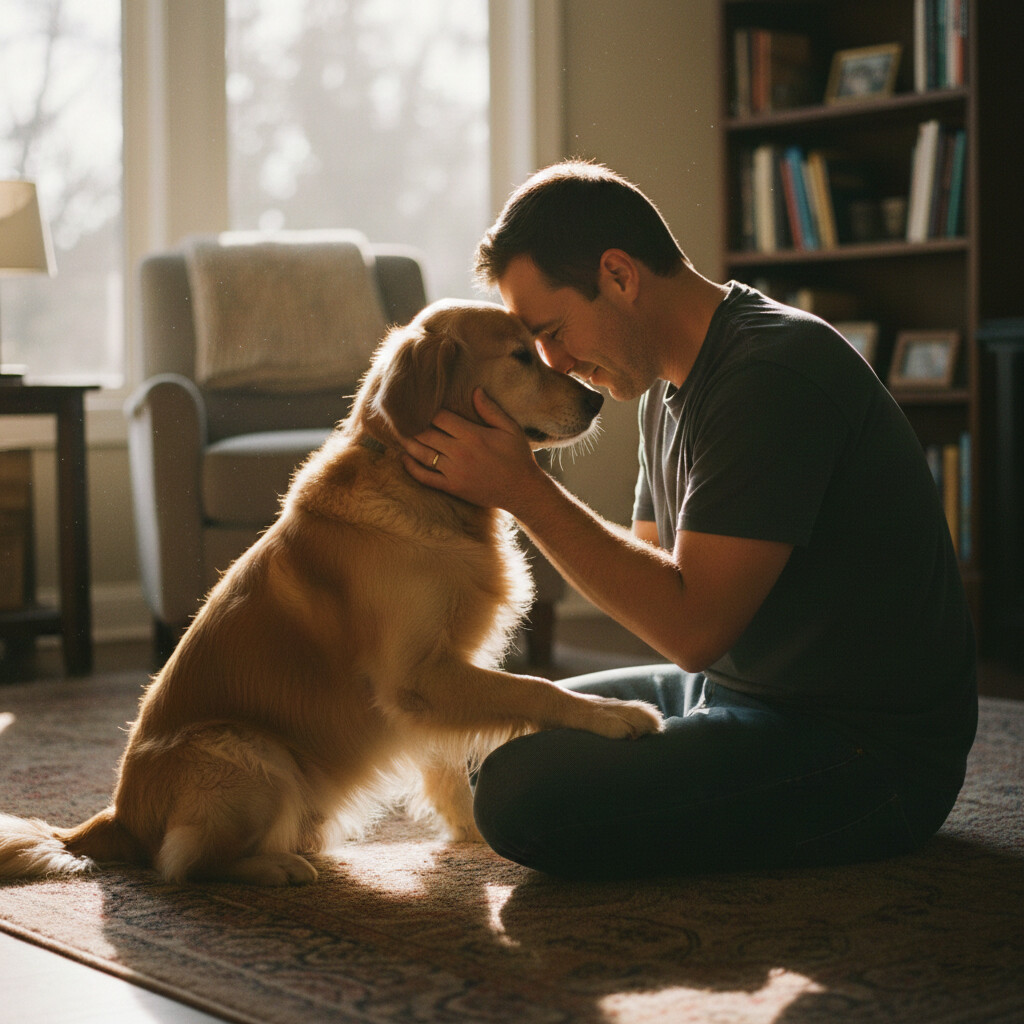
Dogs bond with humans through a unique biological feedback loop involving oxytocin, often called the “love hormone.” When a dog and a human gaze into each other’s eyes, both brains release oxytocin, creating a feeling of deep attachment similar to the bond between a parent and child. This bond is reinforced by thousands of years of co-evolution, where dogs adapted to read human social cues, and the “secure base effect,” where dogs rely on their owners for emotional safety while exploring the world.
Summary Table
| Aspect | Key Details |
| Primary Hormone | Oxytocin (The “Love Hormone”). Released during eye contact and touch. |
| Evolutionary Origin | Secure Base Effect. Dogs view their owners as a safety net, similar to human infants. |
| Psychological Concept | Sustained eye contact, “checking in” during walks, yawning when you yawn, and leaning. |
| Brain Activity | The caudate nucleus (reward center) lights up when dogs smell their owners. |
| Key Signs of Bonding | Sustained eye contact, “checking in” during walks, yawning when you yawn, leaning. |
How Dogs Connect Emotionally With Humans
Have you ever looked into your dog’s eyes and felt a sudden rush of warmth? That isn’t just your imagination; it is pure chemistry.
Scientific research has proven that dogs and humans share a biological connection that is rare in the animal kingdom. It centers on oxytocin, a powerful hormone involved in social bonding and maternal attachment.
When you stare into your dog’s eyes, your oxytocin levels rise. But here is the amazing part: your dog’s oxytocin levels rise too.
Japanese researchers discovered that this “positive loop” is unique to dogs. Wolves, even those raised by humans, do not show this same hormonal spike during eye contact. This suggests that over thousands of years, dogs evolved specifically to hijack this human bonding pathway. They literally evolved to love us.
Read Also: Why Do Dogs Dig Holes?
The “Secure Base” Effect
Psychologists use a term called the Secure Base Effect to describe the relationship between a human parent and a child. A child will happily play and explore a playground as long as they know their parent is nearby. If the parent leaves, the child becomes distressed and stops playing.
Your dog views you the exact same way.
Studies show that dogs play more, explore more confidently, and solve problems faster when their owner is present. You are their anchor. When you are around, the world is a less scary place. This psychological safety net is a massive indicator of a deep, healthy bond.
Evolution: How We Grew Together
The bond between man and dog didn’t happen overnight. It is the result of co-evolution.
Roughly 15,000 to 30,000 years ago, the friendliest wolves began venturing closer to human campfires to scavenge food. These wolves were less aggressive and less fearful. Over generations, humans selected for these friendly traits.
Domesticated Social Intelligence
Unlike other domesticated animals, dogs developed social cognition specifically tuned to humans.
- Reading Gestures: Dogs can understand pointing. If you point at a hidden treat, a dog will look where you point. A chimpanzee (our closest genetic relative) will look at your finger.
- Facial Expressions: Dogs can distinguish between happy and angry human faces.
- Voice Intonation: They process the emotional tone of your voice in the same brain region humans do.
Your Scent is Their Favorite Smell
Your dog experiences the world primarily through their nose, and you are their favorite scent.
Neuroscientist Gregory Berns used fMRI (functional magnetic resonance imaging) to scan the brains of awake dogs. He exposed them to various smells: strangers, other dogs, and their owners.
When the dogs smelled their owners, the caudate nucleus, the brain’s “reward center,r”lit up significantly. This is the same part of the brain that activates when we anticipate love or money. To your dog’s brain, your smell is a tangible reward.
Read Also: How Dogs Adapt to New Homes?
7 Signs Your Dog is Deeply Bonded to You
You don’t need an fMRI machine to know if your dog loves you. Their behavior tells the story every day.
1. The “Check-In.”
When you are at a dog park or hiking off-leash, does your dog periodically look back at you? This is the secure base effect in action. They are making sure you are still there and ensuring you are part of their adventure.
2. Contagious Yawning
You might know that yawning is contagious between humans; it is a sign of empathy. A study at the University of Tokyo found that dogs are more likely to yawn when their owners yawn compared to strangers. It indicates they are emotionally tuned in to you.
3. The “Lean.”
If your dog presses their weight against your legs while you are standing or sits on your feet, they are claiming you. This is a sign of trust and a desire for physical closeness and security.
4. Carrying Your Things
Does your dog greet you with a shoe or a toy in their mouth? They aren’t just looking for playtime. Presenting you with a valued item is a greeting ritual. They are sharing their resources with the pack leader.
5. Sleeping Near You
In the wild, pack members sleep together for warmth and protection. If your dog chooses to sleep in your room (or on your bed), they are identifying you as family. It shows they feel safe enough to be vulnerable around you.
6. Eyebrow Movement
Dogs have a specific muscle (the levator anguli oculi medialis) that allows them to raise their inner eyebrows. This creates those “puppy dog eyes” that humans find irresistible. Research suggests dogs use this facial expression significantly more when looking at humans than at other dogs.
7. Calmness When You Leave
This might sound counterintuitive. Many people think a dog that panics when you leave loves you the most. Actually, a dog with a secure attachment is confident that you will return. Extreme separation anxiety is often a sign of insecurity, not necessarily a deeper bond.
Read Also: Best Dog Breeds for Apartment Living
How to Strengthen Your Bond
Even if you already have a great relationship, you can deepen it with intentional interactions.
Focus on “Active” Walks
Don’t just walk while looking at your phone. Engage with your dog.
- Change directions randomly to keep them focused on you.
- Praise them when they look at you.
- Talk to them.
Hand-Feeding
Try feeding your dog their dinner by hand once in a while. This reinforces that you are the provider of good things and encourages gentle interaction.
Training is Bonding
Training isn’t just about obedience; it’s a team sport. When you teach a dog a new trick, you are communicating across species lines. The mental stimulation and the reward history build massive amounts of trust.
Respect Their Choice
Consent matters. If your dog moves away from a cuddle, let them go. Respecting their space tells them they are safe with you and don’t need to be defensive.
The “Gaze” Exercise
Spend a few quiet moments just stroking your dog and looking softly into their eyes. Do not stare aggressively; keep it soft. This manual trigger of the oxytocin loop acts like a reset button for your relationship, lowering stress for both of you.
Conclusion
The bond between you and your dog is not an accident. It is a biological masterpiece millions of years in the making. From the oxytocin that floods your brain to the way they look to you for safety, your dog is wired to be your partner.
By understanding the science behind their love, you can stop guessing and start appreciating the small signals the lean, the yawn, the gaze, that say, “I am with you.”