
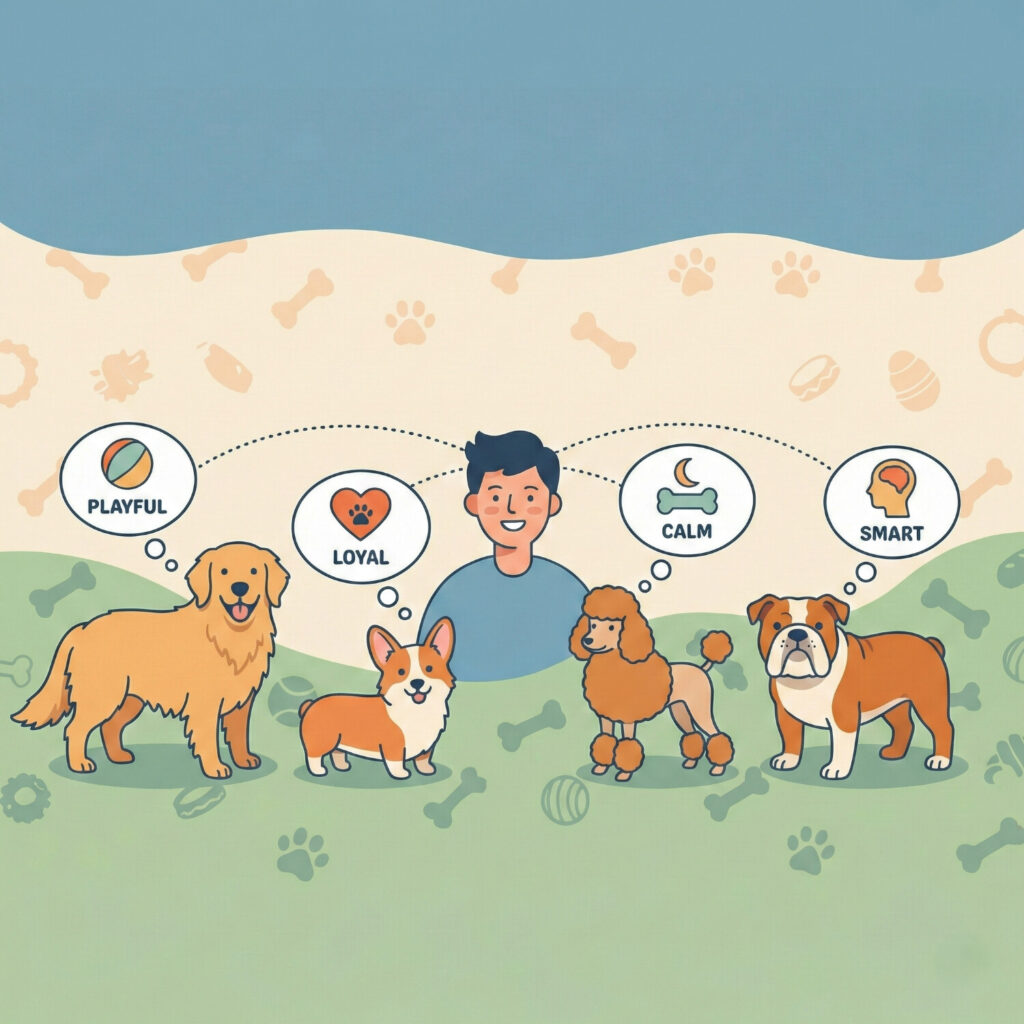
While dog breeds definitely influence physical traits, recent scientific studies show that breed explains only about 9% of a dog’s individual personality. While certain instincts (like herding, pointing, or howling) are highly heritable, complex traits like friendliness, aggression, or anxiety are shaped far more by environment, socialization, and individual upbringing than by breed alone.
Summary Table
| Breed Group | Primary Function | Common Behavioral Tendencies* | Potential Challenges |
| Herding | Moving livestock | Intelligent, high energy, “biddable” (trainable). | Can be nippy (heel biting), anxious if bored. |
| Terrier | Hunting vermin | Feisty, persistent, high prey drive. | Digging, barking, harder to recall off-leash. |
| Working | Guarding/Pulling | Loyal, protective, strong-willed. | Requires strong leadership and socialization. |
| Sporting | Hunting birds | Friendly, energetic, mouthy (love carrying things). | High exercise needs, distractible. |
| Hound | Tracking prey | Independent, nose-driven, stubborn. | Loud baying, tends to ignore commands if a scent is found. |
| Toy | Companionship | Affectionate, alert, people-focused. | Prone to separation anxiety, harder to potty train. |
| Non-Sporting | Varied | Diverse mix; generally companion-focused. | Varies widely (e.g., Bulldog vs. Poodle). |
How Dog Breeds Affect Personality? The “Nature vs. Nurture” Debate
When you think of a Golden Retriever, you likely picture a friendly, goofy, tail-wagging family dog. When you think of a Chihuahua, you might imagine a feisty, nervous ankle-biter. We have spent centuries breeding dogs to look and act a certain way, so it feels intuitive that their personalities are “hardwired” into their DNA.
But is that actually true?
For years, potential dog owners have used breed standards as a shopping list for personality traits. “I want a Border Collie because they are smart,” or “I want a Lab because they are great with kids.” However, modern science is shaking up this belief.
Recent massive genetic studies suggest that while physical traits (like ear shape or coat color) are strictly defined by breed, personality is much more fluid.
This guide will walk you through exactly how breed affects behavior, what science says, and why your dog is an individual first and a breed second.
Read Also: How to Prevent Separation Anxiety in Puppies?
The Science: The 9% Rule
In 2022, a groundbreaking study published in the journal Science analyzed the DNA of over 2,000 dogs and surveyed 18,000 owners. The results were shocking to many breeders and dog lovers.
The researchers found that breed explains only about 9% of the variation in a dog’s behavior.
This means that if you line up ten German Shepherds, they will likely share the same pointy ears and black-and-tan coats, but their personalities could be wildly different. One might be brave and confident, while another is shy and skittish.
What Is Heritable?
If breed doesn’t determine personality, what does it do? Genetics still play a role, but mostly in motor patterns and instincts related to the job the dog was bred to do.
- Biddability (Trainability): Working and herding breeds generally inherit a desire to take direction from humans.
- Retrieving: Retrievers are genetically predisposed to pick things up and carry them.
- Pointing: Pointers will often freeze and lift a paw when they spot prey, even without training.
- Howling: Northern breeds (like Huskies) are genetically prone to vocalize differently than other dogs.
These are “functional” traits. However, “emotional” traits—like how affectionate, fearful, or aggressive a dog is—are largely determined by their life history, not their pedigree.
Breakdown: How Breed Groups Influence Traits
While individual variation is huge, the American Kennel Club (AKC) groups can still give us a “loose blueprint” of what to expect. These traits are historic tendencies, not guarantees.
1. The Herding Group
- Breeds: Border Collie, German Shepherd, Australian Shepherd, Corgi.
- The Job: These dogs were bred to control the movement of other animals.
- Personality Links: They are typically highly intelligent and eager to work. However, that “herding” instinct can translate into trying to herd running children or nipping at heels. They often have high alertness and can be reactive to movement.
- Best For: Active owners who enjoy training and mental games.
2. The Terrier Group
- Breeds: Jack Russell, Bull Terrier, Schnauzer, Westie.
- The Job: To hunt and kill vermin (rats, badgers, foxes) independently.
- Personality Links: Terriers are often described as having “terrier-tude.” They were bred to work alone, without constant human direction. This makes them independent, persistent, and sometimes “stubborn” (they don’t always care what you want them to do). They often have a very high prey drive.
- Best For: Patient owners who appreciate a dog with a strong, feisty character.
3. The Working Group
- Breeds: Rottweiler, Great Dane, Boxer, Siberian Husky.
- The Job: Guarding property, pulling sleds, or performing water rescue.
- Personality Links: These dogs are large and powerful. Guardians (like Rottweilers) may be naturally suspicious of strangers, while sled dogs (like Huskies) are often independent and highly social with other dogs but difficult to keep off-leash (they love to run).
- Best For: Experienced owners who can provide structure and early socialization.
4. The Sporting Group
- Breeds: Golden Retriever, Labrador, Cocker Spaniel, Pointer.
- The Job: Working closely with hunters to find and retrieve game birds.
- Personality Links: This group generally scores highest on “sociability” and “trainability.” They were bred to work with humans, not alone. They tend to be high-energy and very “mouthy” (they interact with the world by chewing or carrying things).
- Best For: Active families and first-time owners willing to exercise them.
5. The Hound Group
- Breeds: Beagle, Bloodhound, Greyhound, Dachshund.
- The Job: Tracking prey by scent or sight.
- Personality Links: Scent hounds are ruled by their nose. If they catch a scent, they may tune you out completely. They are often less “biddable” than sporting dogs because they were bred to follow a trail, not a command. They can be vocal (baying).
- Best For: Owners with secure fences and a lot of patience.
6. The Toy Group
- Breeds: Chihuahua, Pomeranian, Maltese, Pug.
- The Job: To be companions and lap warmers.
- Personality Links: These dogs are bred specifically to bond with humans. They can be extremely affectionate but are also prone to “separation anxiety” because their entire purpose is to be with you.
- Best For: Apartment dwellers and people who want a constant companion.
The Myth of “Dangerous Breeds”
One of the most important findings in modern canine science is regarding aggression. Aggression is not a breed-specific trait.
Legislation often targets breeds like Pit Bulls or Rottweilers, assuming they are genetically wired to be violent. However, scientific data (including the C-BARQ studies) consistently show that:
- Any breed can be aggressive if poorly socialized or abused.
- Smaller breeds (like Dachshunds and Chihuahuas) actually score higher on “aggression toward strangers” than many large breeds, but their bites do less damage, so they are reported less often.
- “Pit Bull” type dogs often score very high on sociability and friendliness toward humans.
Aggression is usually a result of fear, pain, or lack of socialization, not DNA.
Factors That Matter More Than Breed
If breed is only 9% of the puzzle, what makes up the other 91%?
1. Socialization (The Critical Window)
The most defining period of a dog’s life is between 3 and 14 weeks of age. During this time, their brain is developing rapidly. A puppy exposed to various people, sounds, surfaces, and other dogs during this window is statistically more likely to be confident and friendly, regardless of breed. A Golden Retriever kept in isolation during these weeks can easily become fearful and aggressive.
2. Environment and Training
“Nurture” is powerful.
- Reinforcement: Does the owner reward calm behavior? Or do they accidentally encourage jumping and barking?
- Exercise: A bored dog is a destructive dog. A high-energy Border Collie with no job to do will find a job (like chewing your drywall). That’s not “bad personality”; that’s unmet needs.
- Stress: Dogs living in chaotic, loud, or abusive homes will develop anxiety-based behaviors.
3. Individual Genetics
Just like human siblings can be totally different (one is an artist, one is an accountant), puppies from the same litter vary. One might be the “bold explorer,” while another is the “cautious observer.” These individual genetic quirks often outweigh the general breed standard.
Read Also: What Causes Separation Anxiety in Dogs?
How to Choose the Right Dog
Since you can’t rely 100% on the breed label, how do you choose the right dog for your lifestyle?
- Meet the Parents: If buying a puppy, meeting the mother (and father, if possible) gives you the best clue about temperament. Anxious mothers often produce anxious puppies.
- Look for “Lines”: Within a breed, there are “working lines” and “show/pet lines.” A Border Collie from a working farm line will have intense energy that might be too much for a casual owner. A “show line” Border Collie might be calmer.
- Adopt Adult Dogs: The best way to know a dog’s personality is to adopt an adult dog. Their personality is already developed. You don’t have to guess if they will be friendly or calm,you can see it.
- Don’t Buy on Looks: Do not buy a Husky just because they look cool if you live in a hot climate and hate running. Do not buy a Belgian Malinois because you saw one in a movie if you aren’t a professional trainer.
Conclusion
So, how much does a dog’s breed affect its personality? The answer is: It affects their instincts, but not their destiny.
Breed gives us a hint about a dog’s energy levels, their desire to chase, and their motivation to work. But it does not tell us if they will be sweet, cuddly, aggressive, or shy. A dog is not a pre-programmed robot; they are complex living being shaped by the world around them.
When looking for a new best friend, use the breed as a rough guide, but look at the individual dog in front of you. Train them with love, socialize them early, and you will shape their personality far more than their DNA ever could.