
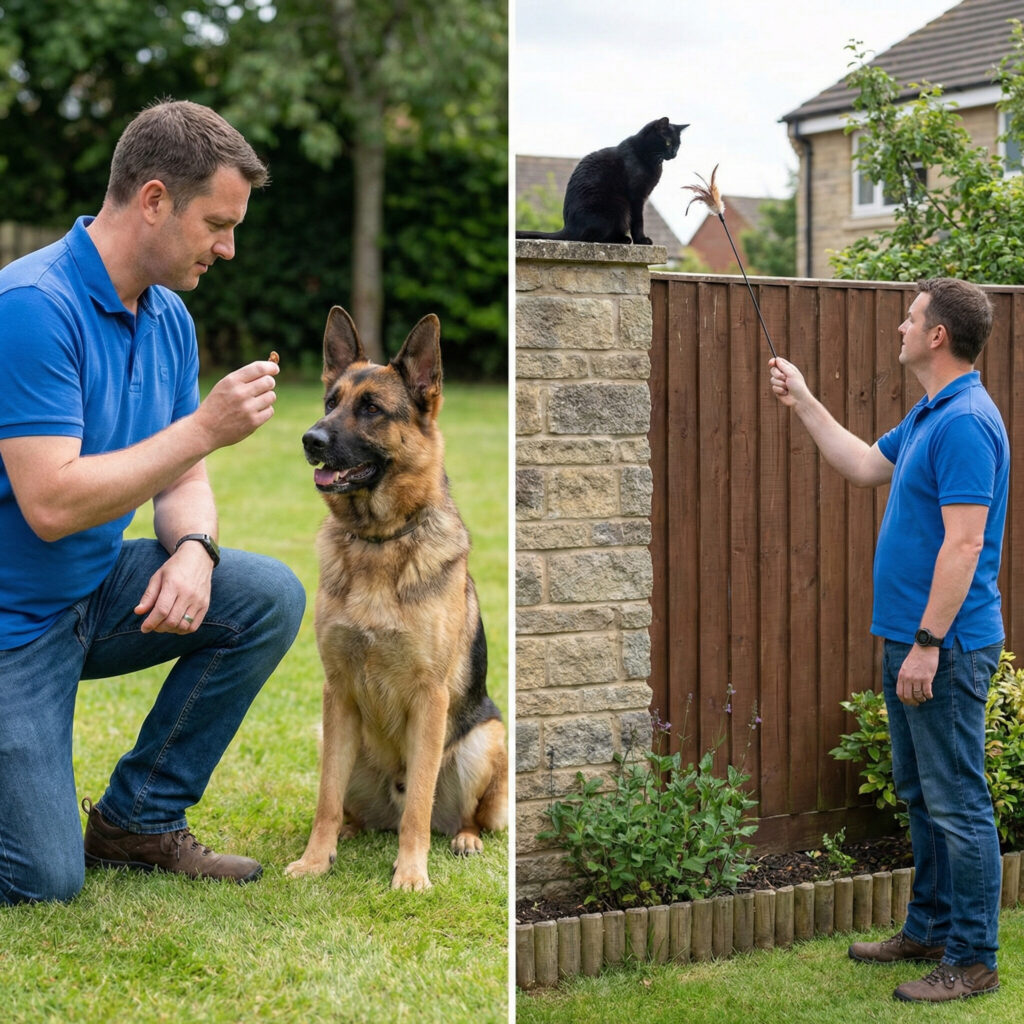
Dogs are generally easier to train than cats. Dogs have a natural desire to please their owners and follow social hierarchy, making them responsive to praise and commands. Cats are solitary hunters by nature; they are independent and do not feel a need to please humans. However, cats are actually easier to “potty train” because their instinct to bury waste makes litter box usage natural, whereas dogs require active housebreaking.
Summary Table: Cat vs. Dog Training
| Feature | Dog Training | Cat Training |
| Primary Motivation | Praise, Food, Play, Social bonding | High-value Food, Comfort |
| Learning Style | Social, Collaborative | Independent, Transactional |
| Attention Span | Longer (varies by breed) | Very short (bursts) |
| Potty Training | Requires weeks/months of effort | Almost instant (instinctive) |
| Desire to Please | High | Low |
| Best Method | Positive Reinforcement | Positive Reinforcement (Clicker) |
| Difficulty Level | Low to Moderate | Moderate to High |
Dog vs Cat Training: Why One Is Easier
When you bring a new pet home, training is usually the first big hurdle. The debate between “dog people” and “cat people” often centers on personality, but when it comes to training, the differences are biological, not just personal preference.
Most people assume dogs are easier to train, and historically, they are right. But “easier” doesn’t tell the whole story. Understanding why a Golden Retriever sits on command while a Tabby knocks a glass off the table requires looking at their history, their brains, and what actually motivates them.
This guide dives deep into the training differences between cats and dogs, helping you understand which pet fits your lifestyle and how to manage expectations for both.
Read Also: How Cats and Dogs Learn From Humans
The Evolutionary Gap
The domestic dog (Canis lupus familiaris) and the domestic cat (Felis catus) took very different paths to our living rooms.
Dogs
- Social Hierarchy: Dogs understand that there is a leader. In a domestic setting, you are the leader.
- Cooperation: They are biologically wired to work with others to achieve a goal.
- Eye Contact: Dogs are one of the few animals that look humans in the eye to gauge emotion and direction.
Cats
- Independence: They do not look to others for cues on how to behave.
- Self-Preservation: A cat’s actions are driven by what is safe and beneficial for the cat, not the group.
- No “Alpha”: You cannot dominate a cat. They do not recognize you as a pack leader; they recognize you as a resource provider (and hopefully a friend).
Why Dogs Are Generally Easier to Train
When we say dogs are easier, we usually mean they are more compliant. You can teach a dog to do something simply because it makes you happy.
The “Desire to Please”
This is the biggest advantage in dog training. Many dog breeds, especially working breeds like Shepherds and Retrievers, find the act of working with a human rewarding in itself. If you cheer and clap when your dog sits, the dog feels good. This social reward system allows you to train dogs using just your voice and affection.
Consistency in Behavior
Dogs are generally consistent. If a dog learns that “Sit” equals a treat, they will likely do it every time, even in different rooms or outside (with practice). Their predictive nature makes building a training routine straightforward.
Wider Range of Motivators
You have many tools to train a dog:
- Food: Almost all dogs are food motivated.
- Toys: A game of tug or fetch can be a reward.
- Praise: Verbal affirmation works wonders.
- Touch: Pets and scratches are highly valued.
Because you have so many “currencies” to pay your dog with, you can keep training sessions fresh and exciting.
Read Also: Problem-Solving Skills: Dogs vs Cats
The Truth About Cat Training
Cats are not untrainable. That is a myth. However, they are transactional. A cat will not sit because it loves you; a cat will sit because you are holding a piece of salmon, and sitting is the fastest way to get it.
“What’s In It For Me?”
Cat training is strictly business. If the reward isn’t high-value enough, the cat will walk away. You cannot force a cat to train, and you cannot shame a cat into obedience. If you try to scold a cat, they don’t feel guilty. They just become afraid of you.
The Window of Opportunity
While you might train a dog for 30 minutes, a cat’s training attention span is roughly 2 to 5 minutes. You have to be incredibly fast. If you miss the moment, the cat loses interest and starts grooming itself or falls asleep.
Deep Dive: Potty Training
Here is the one area where cats are infinitely easier than dogs. This single factor is often why busy professionals choose cats over dogs.
The Cat Advantage: Instinct
You do not actually “train” a cat to use a litter box. It is instinctual. In the wild, cats bury their waste to hide their scent from predators and potential prey.
- The Process: You buy a box, fill it with litter, show it to the cat once, and you are usually done.
- The Effort: Near zero.
The Dog Disadvantage: Housebreaking
Potty training a puppy is a massive undertaking. It involves:
- Schedule: Taking them out every 2 hours.
- Vigilance: Watching for sniffing or circling.
- Correction: Catching them in the act and redirecting.
- Time: It can take months for a dog to be fully reliable.
If you are looking for “easy” in terms of bathroom habits, the cat wins hands down.
Read Also: Cat vs Dog Memory: Who Remembers Better?
Deep Dive: Leash Walking and Recall
If you want a companion to go outside with, the dog is the clear winner.
Recall (Coming When Called)
- Dogs: Recall is a safety command. With practice, a dog will come when called even if they are distracted, because their instinct to rejoin the pack is strong.
- Cats: You can teach a cat to come when called, but it is unreliable. If a cat sees a squirrel or gets spooked, their instinct is to hide, not to run to you. This makes off-leash time with cats dangerous.
Leash Manners
- Dogs: Dogs naturally follow. Walking on a leash aligns with their migratory instincts.
- Cats: Cats are territorial ambush predators. They don’t go for “walks” in straight lines. They wander, stop, sniff, and crouch. Walking a cat on a leash is more like following a cat around while holding a rope.
Motivation and Methods: How to Train Each
The mechanics of training differ greatly. Understanding the methodology is key to success.
Positive Reinforcement (The Gold Standard)
Both species require positive reinforcement. Punishment does not work well for dogs (it damages the bond), and it does not work at all for cats (it creates aggression).
Training a Dog
- Luring: You use a treat to guide the dog’s nose. If you lift the treat up, the butt goes down (Sit).
- Shaping: You reward small steps toward the final behavior.
- Marker Training: Using a clicker or a word like “Yes!” to mark the exact moment the dog did the right thing.
Training a Cat
- Capturing: This is the easiest method for cats. You wait for the cat to do the behavior naturally (like sitting), then you click and treat immediately.
- Targeting: You teach the cat to touch their nose to a stick or your finger. This allows you to move them around without handling them.
- Eliminating Distractions: You cannot train a cat in a noisy room. It must be silent and boring, so the treat is the most interesting thing happening.
Socialization: The Critical Period
Training isn’t just about commands; it’s about how the animal interacts with the world.
Dog Socialization
Dogs have a critical socialization window (usually up to 16 weeks). During this time, you must expose them to people, noises, cars, and other dogs. If you do this well, you get a confident, easy-going dog. A well-socialized dog can go to breweries, parks, and friends’ houses.
Cat Socialization
Cats also have a socialization window (2 to 7 weeks), which is much shorter. Most kittens are adopted after this window closes. This is why many cats are skittish around strangers.
While you can “socialize” a cat to tolerate people, they rarely develop the “go anywhere” confidence of a dog. Training a cat to accept travel or guests is difficult work.
Read Also: Dog vs. Cat Communication Styles
Common Myths Debunked
Myth: “Cats cannot learn tricks.”
Fact: Cats can learn High-Five, Spin, Sit, and even agility courses. The difference is they won’t do it for 20 minutes straight. They will do it 5 times, get their treats, and leave.
Myth: “Old dogs can’t learn new tricks.”
Fact: Dogs are lifelong learners. While puppies soak up information faster, an older dog has a longer attention span and is often calmer, making them easier to train in some respects.
Myth: “Rubbing a dog’s nose in accidents helps.”
Fact: This is outdated and harmful. It teaches the dog to fear you, not to stop peeing inside. It makes training harder, not easier.
Tools of the Trade
To succeed, you need the right equipment. The toolkits look different for each animal.
The Dog Trainer’s Kit
- High-Value Treats: Freeze-dried liver, cheese, or hot dogs.
- Standard Leash: 6-foot fixed length (avoid retractable leashes for training).
- Harness/Collar: A flat collar or a front-clip harness to manage pulling.
- Clicker: For precision training.
- Long Line: For practicing recall in open spaces.
The Cat Trainer’s Kit
- Liquid Treats: Squeeze tubes (like Churu) work best because the cat has to stay close to you to lick it, keeping them engaged.
- Clicker: Essential for marking the split-second behavior.
- Target Stick: A chopstick or specialized target stick to guide movement.
- Cat Tree/Perch: Training often works best when the cat is elevated, as they feel more confident up high.
Conclusion
So, is dog training easier? Yes.
If your goal is a pet that listens to commands, walks on a leash, and comes when called, a dog is the easier path. Their biology is wired to work with you. The friction in training a dog is usually just consistency and time.
However, if your definition of “easy” is a pet that requires less management, the cat wins. You don’t have to housebreak them, you don’t have to teach them not to jump on strangers (usually), and they don’t require daily obedience drills to be happy.
The Verdict
- Choose a Dog if you want a hobby. Training is an active, ongoing process that builds a partnership.
- Choose a Cat if you want a roommate. Training is possible and fun, but it is on their terms, and they will never be your employee.