
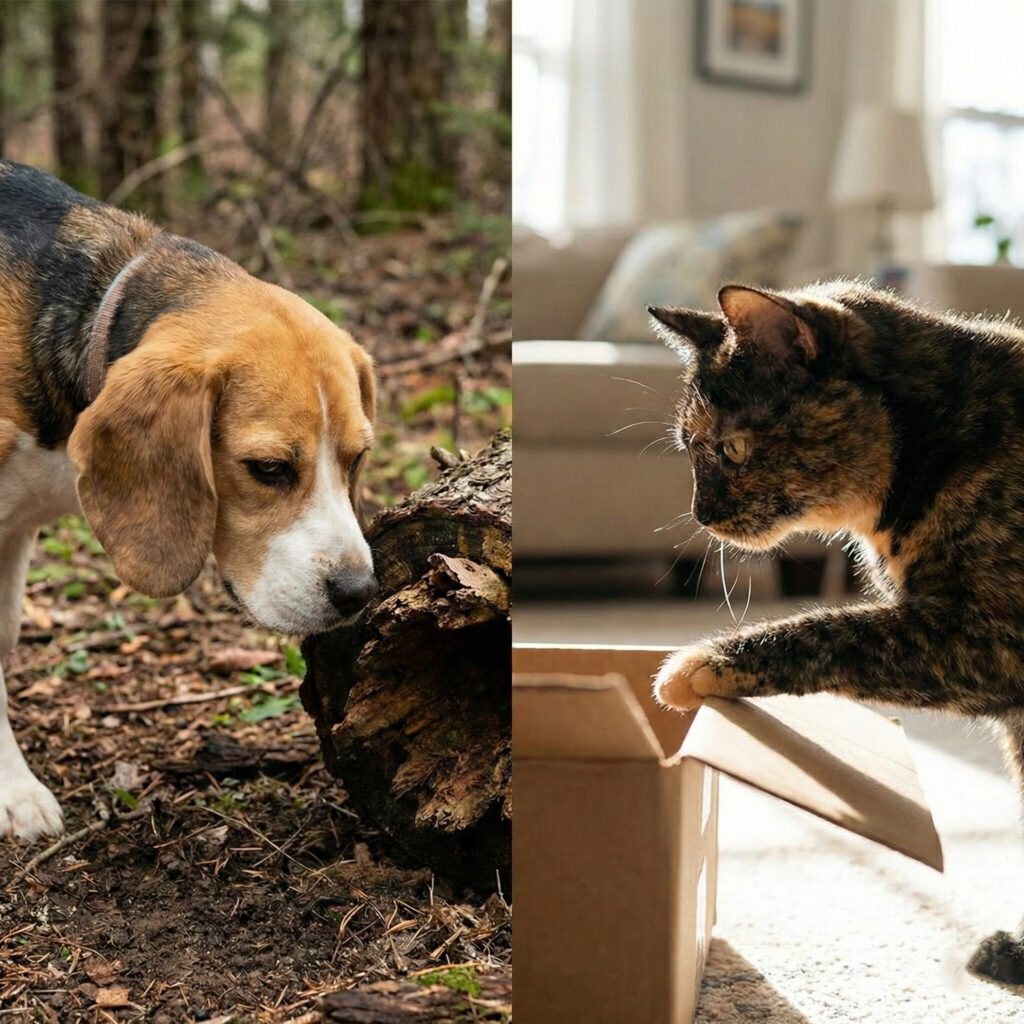
Dogs and cats express curiosity differently. Dogs explore boldly using their sense of smell and often look to humans for guidance. Cats explore cautiously using vision and hearing, preferring to observe from a distance or high vantage point before engaging to ensure safety.
Summary Table
| Feature | Dog (Canine) | Cat (Feline) |
| Primary Sense | Smell (Olfactory) | Sight & Hearing (Visual/Auditory) |
| Exploration Style | Bold, investigative, nose-first | Cautious, stealthy, observation-first |
| Social Reliance | High (looks to owner for help) | Low (independent problem solving) |
| Risk Tolerance | Generally High (Neophilic) | Generally Low (Neophobic) |
| Motivation | Scavenging, social connection | Hunting, territorial security |
| Territory Usage | Horizontal (ground level) | Vertical (high shelves, trees) |
Dog vs Cat Curiosity Compared: The Ultimate Guide
We often hear the phrase “curiosity killed the cat,” but anyone who has owned a dog knows that canines are just as inquisitive, if not more so. The difference lies not in the amount of curiosity, but in the method and motivation.
By understanding how your pet processes the world, you can better provide for their mental health and enrichment needs. This guide breaks down the biological and evolutionary reasons behind why your dog sniffs everything and why your cat knocks things off the table.
Read Also: Adaptability: Cats vs Dogs in New Environments
1. The Evolutionary Roots of Exploration
To understand why our pets act the way they do, we must look at their ancestors. These ancient survival instincts still drive their modern behaviors.
The Canine
Domestic dogs also have a strong history as scavengers. This combination created an animal that needs to investigate new objects to determine if they are food, a friend, or a threat.
Because they evolved in groups, they have a “safety in numbers” mentality. This allows them to be bolder in their exploration. If a dog encounters something confusing, their first instinct is often to look at their human for a cue.
The Feline
A cat is both a predator of mice and prey to larger animals like coyotes or owls. This dual status dictates their curiosity. A cat must know every inch of its territory to survive.
They need to know where the escape routes are and where the prey is hiding. Their curiosity is driven by a need for control and security. Unlike dogs, they cannot rely on a pack to back them up, so they are naturally more cautious.
2. Sensory Curiosity: Nose vs. Eyes
The tools your pets use to satisfy their curiosity are vastly different. While humans are visual creatures, our pets live in sensory worlds we can barely imagine.
The Dog’s Nose: A Chemical Map
When a dog walks into a new room, they are “reading” the air. A dog’s brain is dominated by the olfactory cortex. They have up to 300 million scent receptors, compared to our 6 million. When a dog pulls on the leash to sniff a tree, they aren’t just smelling bark; they are reading a social media feed of who was there, what they ate, and how healthy they are.
- Direct Investigation: Dogs will put their face directly into the source of the smell.
- Taste Testing: Dogs are more likely to lick or mouth an object to understand it.
- Tracking: Their curiosity is linear; they follow a scent trail until they find the source.
Read Also: Dogs vs Cats: Who Understands Human Emotions Better
The Cat’s Eyes and Ears: The Surveillance System
Cats are visual and auditory specialists. Their curiosity is often satisfied from a distance before they ever make physical contact. A cat’s whiskers also play a huge role, detecting changes in air currents that might indicate movement.
- Observation: A cat will sit on a high perch and watch a new object for minutes or hours.
- Motion Sensitivity: Their eyes are wired to detect the slightest movement, triggering their chase instinct.
- Verticality: Cats satisfy curiosity by climbing. They need to see the “layout” of the room from above to feel secure.
3. Behavioral Expressions of Curiosity
How does this biology translate into day-to-day behavior? You can spot the difference in how they handle new objects and barriers.
Object Permanence and Problem Solving
Scientific studies on “object permanence” (knowing something exists even when you can’t see it) show interesting differences. If you hide a toy behind a barrier:
- Dogs: They will often try to brute-force their way to it or, crucially, stop and look at their owner to “ask” for help. This is a sign of social intelligence.
- Cats: They rarely look to humans for help. They will persistently try to solve the puzzle themselves, often using their paws to reach under or around barriers. This is independent intelligence.
Neophilia vs. Neophobia
- Neophilia (Love of the new): Dogs are generally neophilic. They get excited by new toys, new guests, and new walking routes. Novelty is a reward in itself.
- Neophobia (Fear of the new): Cats are often neophobic. A new piece of furniture can cause stress because it changes their territorial map. Their curiosity about a new box is a mix of fear and a need to reclaim the territory. They investigate to ensure it is safe, not necessarily because they enjoy the novelty.
Read Also: Cats vs Dogs: Who Learns Faster?
4. The “Cat Knock” vs. The “Dog Chew”
Two of the most destructive curiosity behaviors are actually investigations in disguise.
Why Cats Knock Things Over
When a cat pushes a glass off a table, they are engaging in a physics experiment. They are testing:
- Is it alive? Does it move when I touch it?
- Sound: What noise does it make?
- Owner Reaction: Does this action get the human’s attention?
Why Dogs Chew Everything
Puppies, in particular, explore with their mouths much like human babies explore with their hands. Because dogs don’t have fine motor control in their paws, the mouth is their primary tool for tactile investigation. They chew to test texture, hardness, and taste. If it feels good or tastes interesting, they keep chewing.
5. Optimizing Enrichment for Each Species
Knowing these differences helps you create better play and enrichment strategies.
For Dogs: The Scavenger Hunt
Since dogs are nose-driven scavengers, their curiosity is best satisfied through scent work.
- Sniffari Walks: Let your dog sniff as much as they want on walks. This is mental exhaustion for them.
- Puzzle Toys: Use food puzzles that require them to use their nose and paws to unlock treats.
- Hide and Seek: Hide treats around the living room and tell them to “find it.”
For Cats: The Vertical Hunt
Cats need to stalk and observe. Their enrichment should focus on hunting sequences and vertical territory.
- High Vantage Points: Install cat shelves or tall trees so they can observe household activity from above.
- Feather Wands: Mimic the movement of a bird. Allow the cat to stalk, pounce, and “kill” the toy.
- Box Exploration: Leave new cardboard boxes out. This provides a safe, enclosed space for them to investigate new smells.
Read Also: Dog vs Cat Training: Why One Is Easier
6. Safety Considerations
Curiosity can be dangerous for both species, but the risks differ.
Dog Risks
- Ingestion: Because dogs explore with their mouths, they are at high risk for bowel obstructions (swallowing socks, rocks, toys).
- Running Off: Their scent drive can override their recall training. If they catch a scent, they may run blindly into traffic.
Cat Risks
- Enclosed Spaces: Cats love tight spaces. They often get trapped in dryers, closets, or car engines.
- Heights: “High-rise syndrome” occurs when curious cats fall from windows or balconies while trying to catch a bird or insect.
Summary
While both dogs and cats are driven to explore, they do so from opposite ends of the spectrum. The dog is the optimistic detective, barging into the room nose-first, ready to find food or friends. The cat is the skeptical surveyor, analyzing every angle from a distance before deciding it is safe to engage. Appreciating these distinct styles allows us to respect their nature, letting the dog sniff the hydrant and letting the cat inspect the new grocery bag in peace.