
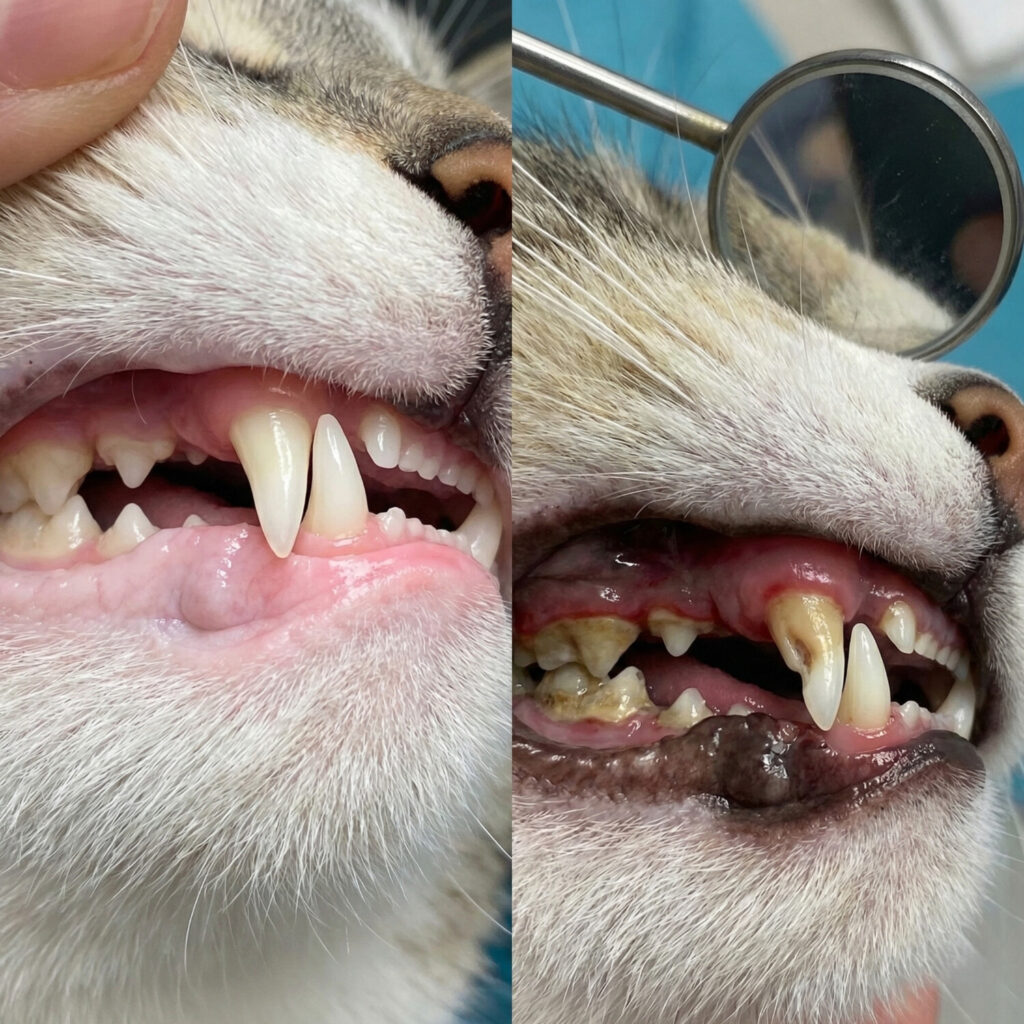
Common dental problems in cats include periodontal disease, tooth resorption, and stomatitis. Periodontal disease starts as gingivitis and can advance to tooth loss. Tooth resorption involves the body breaking down the tooth structure. Stomatitis is a painful inflammation of the mouth. Regular veterinary checkups and home brushing are essential for prevention.
Summary Table: Feline Dental Issues
| Dental Condition | Primary Cause | Key Symptoms | Common Treatment |
| Gingivitis | Plaque accumulation | Red or swollen gums | Professional cleaning |
| Periodontitis | Untreated gingivitis | Gum recession, loose teeth | Extraction, deep cleaning |
| Tooth Resorption | Unknown (idiopathic) | Missing teeth, oral pain | Extraction of affected teeth |
| Stomatitis | Immune overreaction | Widespread mouth inflammation | Full mouth extraction |
| Fractured Teeth | Trauma or chewing hard items | Drooling, avoiding food | Root canal or extraction |
| Halitosis | Bacteria in the mouth | Foul smelling breath | Cleaning, addressing root cause |
Common Dental Problems in Cats
Dental health is often the most overlooked aspect of feline care. Many owners assume that bad breath is normal for cats. It is not. Dental disease is the most common health issue diagnosed in cats. By the age of three, the vast majority of cats have some form of dental disease.
This is critical because cats are masters at hiding pain. A cat with a mouth full of rotting teeth might still eat dry food because their survival instinct tells them to eat. This forces owners to be proactive. You must look for signs of trouble before your cat stops eating.
Read Also: Why Do Cats Limp Suddenly?
This guide details the specific dental diseases that affect cats, how to spot them, and how veterinarians treat them.
The Anatomy of Feline Teeth
To understand dental disease, you need to know what a healthy mouth looks like. Adult cats have 30 permanent teeth. They are designed for shearing and tearing meat, not for grinding grains.
The teeth include:
- Incisors: Small teeth in the front used for grooming and grasping.
- Canines: Long fangs used for puncturing and holding prey.
- Premolars: Teeth behind the canines used for shearing.
- Molars: The teeth in the far back.
A healthy mouth has pink gums. The teeth should be white and free of buildup. The gums should meet the tooth flush, without redness or bleeding. Any deviation from this indicates a potential problem.
Signs of Dental Pain in Cats
Cats rarely whine or cry when they have a toothache. They suffer in silence. You must observe their behavior closely to detect issues.
Watch for these warning signs:
- Bad Breath (Halitosis): A strong, foul odor is a primary indicator of infection.
- Changes in Eating Habits: The cat may chew on one side of the mouth or drop food while eating.
- Chattering: The jaw may tremble or chatter when the cat sees food or tries to groom.
- Reduced Grooming: A painful mouth makes grooming difficult, leading to a matted or greasy coat.
- Pawimg at the Mouth: The cat may rub its face on the floor or paw at its mouth to relieve pain.
- Weight Loss: As eating becomes painful, the cat consumes fewer calories.
- Drooling: Excessive salivation, sometimes with blood, is a sign of severe oral disease.
Periodontal Disease
Periodontal disease is the inflammation of the structures that support the teeth. This includes the gums, the periodontal ligament, and the jawbone. It is a progressive condition that starts with plaque.
The Process of Decay
Plaque is a biofilm made of bacteria and food particles. It forms on the teeth daily. If it is not removed, it hardens into tartar (calculus) within 24 to 48 hours. Tartar is rough and provides a surface for more plaque to attach.
As bacteria multiply, they creep under the gumline. This triggers the immune system. The resulting inflammation damages the tissues holding the tooth in place.
Stage 1: Gingivitis
Gingivitis is the earliest stage of periodontal disease. It is the inflammation of the gums.
- Signs: A thin red line appears along the gum margin where the gum meets the tooth. The gums may bleed easily when touched.
- Reversibility: This is the only reversible stage. With professional cleaning and home care, the gums can return to full health.
Stage 2: Early Periodontitis
If gingivitis is ignored, it advances to periodontitis. The attachment between the tooth and gum begins to break down.
- Signs: The gums swell and pockets form between the tooth and gum. Bacteria fill these pockets.
- Damage: The bone usually remains intact in this stage, but the soft tissue attachment is lost.
- Treatment: Professional cleaning and application of antibiotic gels may help, but lost attachment cannot be regrown.
Stage 3: Moderate Periodontitis
The infection moves deeper.
- Signs: The gums recede, exposing the tooth roots. The teeth may become mobile (loose).
- Damage: Significant bone loss occurs. Up to 50 percent of the bone support may be destroyed.
- Treatment: Extractions are often necessary for teeth that have lost too much support.
Stage 4: Advanced Periodontitis
This is the final stage.
- Signs: Heavy tartar covers the teeth. Pus may be visible at the gumline. The breath smells like decay.
- Damage: More than 50 percent of the bone support is gone. The infection may spread into the bloodstream, affecting the kidneys, liver, and heart valves.
- Treatment: Extraction is the only humane option to remove the source of infection and pain.
Read Also: Why Do Cats Hide When They’re Sick
Tooth Resorption
Tooth resorption is a condition where the body breaks down and absorbs the tooth structure. It is formerly known as Feline Odontoclastic Resorptive Lesions (FORL). It is incredibly common, affecting nearly three out of four cats over the age of five.
The Mechanism
Cells called odontoclasts, which are responsible for breaking down baby teeth, become reactivated in adult cats. They start attacking the permanent teeth. The cause is unknown (idiopathic).
Types of Resorption
- Type 1: Associated with inflammation and periodontal disease. The roots remain intact but the crown is destroyed.
- Type 2: The roots turn into bone. The root structure disappears on X-rays as it merges with the jaw.
Symptoms
The lesion usually starts at the gumline. It looks like a pink spot on the tooth. The gum tissue grows over the hole in the tooth to protect it. This is extremely painful. If you touch this spot (under anesthesia), the cat’s jaw will often spasm.
Treatment
Fillings do not work for resorption. The process continues regardless of restoration. The only treatment is extraction. If the roots have turned to bone (Type 2), the vet may perform a crown amputation, removing the top of the tooth and letting the gums heal over the root.
Read Also: Why Do Cats Stare at Walls?
Feline Stomatitis
Feline Chronic Gingivostomatitis (FCGS) is a severe, painful condition. It is an overreaction of the immune system to plaque bacteria. Even a tiny amount of plaque triggers massive inflammation.
Appearance
The entire mouth looks angry and raw. The inflammation is not limited to the gums around the teeth. It spreads to the back of the throat (the caudal stomatitis) and the inside of the cheeks. The tissue looks like bright red, ulcerated meat.
Impact on Quality of Life
Cats with stomatitis are in constant agony. They often stop eating because opening their mouth hurts too much. They may approach the food bowl, hiss at it, and run away.
Treatment Options
Medical management is rarely successful long-term.
- Steroids and Antibiotics: These provide temporary relief but do not cure the disease. The symptoms usually return once the drugs wear off.
- Full Mouth Extraction: The gold standard treatment is removing the teeth. This removes the surface that plaque attaches to. Without the teeth (and the plaque), the immune system calms down. About 90 percent of cats see significant improvement or a complete cure after full mouth extractions.
Read Also: Why Do Cats Prefer Certain People?
Fractured Teeth
Cats are active predators and jumpers. This lifestyle puts their teeth at risk of trauma. The most commonly broken teeth are the upper canines (fangs).
Causes
- Falls or high-impact landings.
- Running into objects.
- Chewing on metal cages or hard toys.
The Danger of Exposed Pulp
If a fracture exposes the pulp canal (the center of the tooth containing nerves and blood vessels), it is a medical emergency. Bacteria enter the exposed pulp and travel down to the root tip. This causes a tooth root abscess.
Treatment
You cannot “watch and wait” with a broken tooth.
- Root Canal Therapy: A veterinary dental specialist removes the pulp and seals the tooth. This saves the tooth structure.
- Extraction: The tooth is removed completely to prevent infection.
Oral Tumors
While less common than periodontal disease, oral tumors are a serious concern. Squamous Cell Carcinoma (SCC) is the most common oral cancer in cats.
Signs of Tumors
- Swellings in the jaw or cheek.
- Loose teeth in an otherwise healthy mouth.
- Unexplained bleeding.
Early detection is difficult because these tumors often hide under the tongue or in the back of the mouth. By the time symptoms are obvious, the cancer is often advanced.
The Veterinary Dental Procedure
Proper dental treatment requires general anesthesia. You cannot perform a thorough dental cleaning on an awake cat. It is unsafe and ineffective.
Anesthesia Safety
Many owners fear anesthesia. However, modern veterinary protocols are very safe. The vet will perform pre-anesthetic blood work to check kidney and liver function. During the procedure, the cat is intubated to protect the airway and supply oxygen. A dedicated nurse monitors heart rate, blood pressure, and oxygen levels.
Steps of a Professional Cleaning (Prophylaxis)
- Scaling: An ultrasonic scaler removes tartar from the crown of the tooth.
- Subgingival Scaling: The vet cleans under the gumline. This is the most important step for preventing disease.
- Probing: Each tooth is probed to measure pocket depth and check for resorption.
- Dental X-rays: This is mandatory. 60 percent of the tooth is under the gumline. X-rays reveal root abscesses, bone loss, and resorption that are invisible to the naked eye.
- Polishing: Scaling leaves microscopic scratches on the enamel. Polishing smooths the surface to slow down future plaque buildup.
Read Also: What Are The Signs Of A Stressed Cat?
Home Care and Prevention
You can significantly delay the progression of dental disease with home care. The goal is to remove plaque before it hardens into tartar.
Tooth Brushing
Daily brushing is the gold standard.
- Tools: Use a small toothbrush or a finger brush designed for cats.
- Toothpaste: Never use human toothpaste. It contains fluoride and foaming agents that are toxic to cats. Use a poultry or malt-flavored veterinary toothpaste.
- Technique: Focus on the outside surfaces of the teeth. The cat’s tongue cleans the inside surfaces. Start slowly, letting the cat lick the paste, then gradually introduce the brush.
Dental Diets
Prescription dental diets use a specialized kibble structure. The kibble is larger and fibrous. It does not shatter when bitten. Instead, the tooth sinks into the kibble, and the fibers scrub the surface of the tooth like a squeegee.
Water Additives and Gels
If your cat refuses brushing, chlorhexidine rinses or water additives can help reduce bacterial load. However, they are not as effective as mechanical brushing.
Conclusion
Dental disease is not just a cosmetic issue. It is a source of chronic pain and systemic inflammation. A healthy mouth extends your cat’s lifespan and improves their daily comfort.
Do not wait for your cat to show signs of illness. Schedule annual wellness exams where the vet checks the teeth. If the vet recommends a cleaning, do not delay. Treating gingivitis is much easier and cheaper than extracting a mouth full of resorbed or rotten teeth. Proactive dental care is one of the best investments you can make in your cat’s health.
Next Steps for Cat Owners
- Lift your cat’s lip today and look at the gums. If you see red lines or brown buildup, call your vet.
- Start a routine of getting your cat used to having their mouth touched.
- Ask your vet about the Veterinary Oral Health Council (VOHC) seal of approval when buying dental treats or diets.