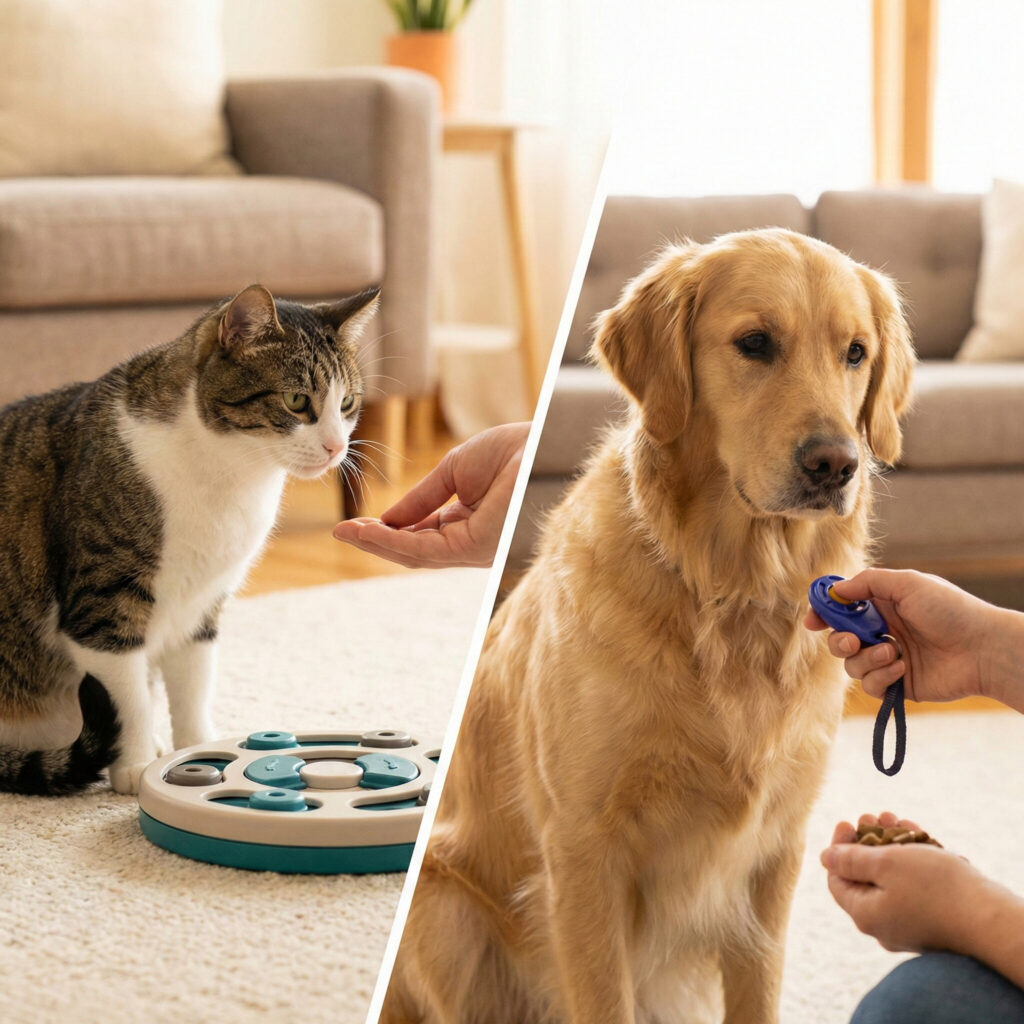
Generally, dogs learn faster when it comes to obedience and following commands because they have been bred for thousands of years to cooperate with humans. They are motivated by social praise and food. Cats can learn just as quickly, but they are less motivated to please humans. Cats excel at independent problem-solving and observational learning. If the test involves complex problem-solving rather than obedience, cats often perform equally well or better.
Summary Table
| Feature | Dogs | Cats |
| Primary Motivation | Social praise, food, play | Food, hunting drive, curiosity |
| Learning Speed | Fast (for commands/tricks) | Varies (fast if highly motivated) |
| Social Intelligence | High (reads human gestures well) | Moderate (reads humans for needs) |
| Attention Span | Longer (sustained focus) | Short (bursts of focus) |
| Best Training Method | Repetition + Reward | Short sessions + High-value treats |
| Problem Solving | Trial and error, looks to humans for help | Observation, independent manipulation |
Cats vs Dogs: Who Learns Faster
The debate between dog owners and cat owners is endless. Dog lovers claim their pets are smarter because they can learn to sit, stay, and roll over in an afternoon. Cat lovers argue that their pets are actually superior because they are too independent to perform tricks for mere entertainment.
When we ask “who learns faster,” we have to define what they are learning. Are we measuring how fast they learn to follow a hand signal? Or are we measuring how fast they can figure out how to open a door?
Science tells us that both animals are highly intelligent, but they possess different types of intelligence. Their learning speeds depend entirely on their evolutionary history and what motivates them. This guide breaks down the science of animal cognition to settle the score.
Read Also: Dog vs Cat Training: Why One Is Easier
Brain Power: The Hardware
Is one brain better than the other? Scientists use different metrics to measure brain power.
Encephalization Quotient (EQ)
This measures brain size relative to body size.
- Dogs: Have a slightly higher EQ than cats.
- Cats: Have a lower EQ, but their brain structure is remarkably similar to humans in the sections that control emotion.
Neuron Count
A 2017 study counted the neurons in the cerebral cortex (the part of the brain associated with thinking and planning).
- Dogs: Approximately 530 million cortical neurons.
- Cats: Approximately 250 million cortical neurons.
While dogs technically have more “computing power” in the cortex, this doesn’t automatically mean they learn faster. It just means they might have more capacity for complex social processing. Cats have an extremely efficient brain structure optimized for sensory input and movement.
Read Also: How Cats and Dogs Learn From Humans
How Dogs Learn
Dogs are masters of associative learning combined with social referencing.
1. Social Motivation
Dogs are unique in the animal kingdom because they bond with humans essentially the same way human infants bond with parents. If a dog encounters a problem it can’t solve (like a treat inside a locked box), it will look at its human owner for help. This reliance on humans makes them very easy to train.
2. Understanding Gestures
Dogs can understand human pointing. If you point at a cup with food under it, a dog will investigate that cup. Chimpanzees and wolves cannot do this naturally. This ability allows dogs to learn commands very quickly because they are constantly watching us for cues.
3. Repetition and Reward
Dogs respond well to repetition. If you say “sit” and give a treat five times, the dog understands the pattern. They are willing to repeat the action 20 times in a row because the social interaction is rewarding in itself.
How Cats Learn
Cats are masters of observational learning and operant conditioning, but on their own terms.
1. “What’s in it for me?”
Cats are not motivated by praise. Telling a cat “Good boy!” means nothing to them. They are motivated almost exclusively by high-value rewards (meat, tuna) or the hunting drive. To make a cat learn fast, the reward must be worth the effort.
2. Observation
Cats are excellent observational learners. There are many documented cases of cats learning to open doors, turn on faucets, or open latches simply by watching their owners do it. They don’t need to be “taught”; they just watch and replicate if they want the result.
3. Short Burst Attention
You cannot drill a cat for 30 minutes. A cat learns in bursts of 2 to 5 minutes. If they get bored, they walk away. This often leads people to believe cats are “slow” learners, but in reality, they just have a lower tolerance for repetitive, boring tasks.
Read Also: Problem-Solving Skills: Dogs vs Cats
The Experiment: Who Wins in Tests?
Scientists have run various experiments to compare the two.
The Maze Test
In maze tests, cats often outperform dogs in memory retention if they are motivated to escape the maze. However, if the cat is comfortable in the maze, it might just sit down and groom itself. The dog will run the maze quickly to find the owner.
- Winner: Dogs (for speed), Cats (for memory).
The Puzzle Box
Edward Thorndike, a famous psychologist, put cats in “puzzle boxes” where they had to pull a lever to escape and get fish. Once the cats figured out the lever, they became faster and faster, eventually escaping immediately.
- Winner: Tie. Both animals solve mechanical puzzles well, but dogs will often give up and look at humans, while cats will keep trying to manipulate the object.
The Pointing Test
As mentioned earlier, if you point at food, dogs go to it. Cats often look at your finger, not the food.
- Winner: Dogs. They understand human communication better.
Why Dogs Seem Faster (The “Obedience Bias”)
Most people confuse “obedience” with “intelligence.”
If you judge a fish by its ability to climb a tree, it will seem stupid. If you judge a cat by its ability to come when called, it will seem slow.
Dogs seem faster because their learning style matches what humans want: Control.
We want pets that sit, stay, and come. Dogs love this.
Cats learn things like:
- How to wake you up at 4 AM for food.
- Exactly where to stand to trip you.
- How to open the cabinet where the treats are.
These are complex behaviors that cats learn very quickly. The difference is that the cat chose to learn them; you didn’t teach them.
Practical Guide: Training Differences
If you are trying to teach a new skill, you must approach cats and dogs differently.
Training a Dog
- Use High Energy: Excited tones work well.
- Lure and Reward: Use a treat to guide their nose into a sit or down position.
- Chain Commands: You can teach “Sit,” then “Shake,” then “Down” all in one session.
- Consistency: Use the same word and gesture every time.
Training a Cat
- Use High-Value Treats: Dry kibble won’t work. Use wet food, tuna, or freeze-dried chicken.
- Clicker Training: This is essential for cats. A “click” marks the exact moment they did the right thing.
- Keep it Quiet: Loud cheering scares cats.
- Wait for the Behavior: Capture the behavior. If the cat sits, click and treat. Eventually, they will sit to get the treat.
- End Before They Are Bored: Stop while the cat is still interested.
Read Also: Cat vs Dog Memory: Who Remembers Better?
Myths Debunked
Myth 1: Cats cannot be trained.
Fact: Cats are easily trained. They are popular in Hollywood movies because they can be taught to hit marks, jump, and meow on cue. The famous “Acro-Cats” are a traveling circus of house cats that push carts and jump through hoops.
Myth 2: Dogs are smarter because they have bigger brains.
Fact: Brain size isn’t everything. Raccoons have small brains but are incredibly crafty. Intelligence is about adaptation. Cats are perfectly adapted to be solitary super-predators.
Myth 3: Old dogs (and cats) can’t learn new tricks.
Fact: Both animals possess neuroplasticity (the ability of the brain to change) throughout their lives. Senior pets take a little longer, but they absolutely can learn.
Conclusion
So, who learns faster?
If we are talking about learning a command from a human, the Dog is the clear winner. They are biologically engineered to understand us and want to work for us. You can teach a dog a basic command in ten minutes.
If we are talking about learning to manipulate an environment to get what they want, the Cat is a fierce competitor. A cat can figure out how to navigate a complex obstacle course to reach a high shelf or open a latch just as fast as a dog—sometimes faster, because they don’t wait for permission.
The Bottom Line:
- Want a partner who follows instructions quickly? Get a Dog.
- Want a roommate who figures things out on their own? Get a Cat.
What You Can Do Next
Test your pet’s cognitive style today. Take three plastic cups and hide a treat under one while your pet watches. Shuffle them slowly.
- Does your pet go straight to the correct cup? (Memory/Object Permanence)
- Does your pet look at you for a hint? (Social Reliance)
- Does your pet knock all the cups over? (Brute Force Problem Solving)
This simple game will reveal exactly how your specific pet thinks and learns.