
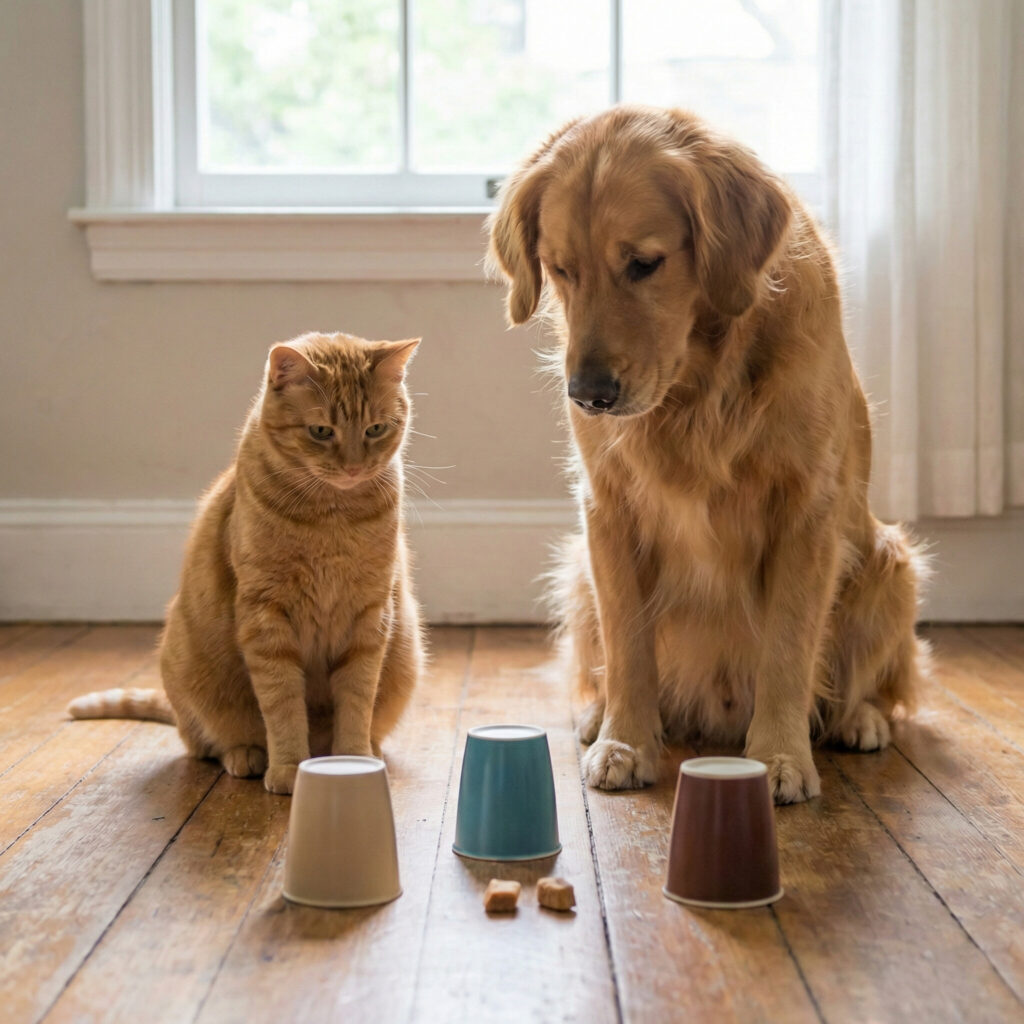
When it comes to short-term memory, cats are the clear winners. Studies suggest cats can retain information for up to 16 hours, whereas dogs typically forget specific details within 2 minutes. However, both animals possess excellent long-term associative memory, allowing them to remember their owners, training, and emotional experiences for years. While cats excel at spatial memory (remembering locations), dogs have superior olfactory memory (remembering scents).
Summary Table
| Feature | Dog Memory | Cat Memory | The Winner |
| Short-Term Duration | ~27 seconds to 2 minutes | Up to 16 hours | Cat |
| Long-Term Type | Associative & Olfactory | Associative & Spatial | Tie |
| Spatial Memory | Good (relies on scent/landmarks) | Excellent (mental mapping) | Cat |
| Social Memory | Remembers faces/smells intensely | Remembers routines/handlers | Tie |
| Key Driver | Smell (Olfactory) | Sight & Location | Context Dependent |
| Problem Solving | Trial and error / Ask human | Observation / Independent | Cat |
Cat vs Dog Memory: Who Remembers Better
The debate between “cat people” and “dog people” often centers on intelligence, but memory is a different ballgame. You might notice your dog forgets he just ate five minutes ago, while your cat holds a grudge about a vet visit from last year.
Science confirms that these pets remember the world differently. It is not just about who is smarter; it is about how they evolved to survive. Dogs are pack animals that rely on social cues and scent. Cats are solitary hunters that rely on stealth and mapping their territory.
This guide breaks down exactly how their brains store information, from short-term working memory to long-term emotional bonds.
Read Also: Dog vs. Cat Communication Styles
Short-Term Memory: The 10-Minute vs. 16-Hour Gap
Short-term memory (often called working memory) is the ability to hold a piece of information in the brain for immediate use. This is where the biggest difference lies.
Dogs: Living in the Moment
Research indicates that dogs have a very limited short-term memory span. A 2014 study often cited by National Geographic suggests that the average dog forgets an arbitrary event within 2 minutes. Some data even points to a window as short as 27 seconds.
This explains why:
- You cannot punish a dog for an accident they had 20 minutes ago; they literally do not remember doing it.
- They greet you like you have been gone for years, even if you only checked the mail.
Cats: The Long-Wait Strategists
Cats blow dogs out of the water here. Studies have shown that cats can remember “where” an object (like food) is hidden for up to 16 hours.
In the wild, a cat might spot a mouse hole but know the mouse isn’t out yet. They need to remember that specific location and return to it hours later. This survival mechanism requires a robust working memory.
Key Takeaway: If you hide a toy, your dog might forget it exists in a minute. Your cat will remember exactly where you put it when they decide they want to play later.
Long-Term Memory: Remembering You
While short-term memory varies, long-term memory is strong in both species. This memory is not about facts (like “2+2=4”); it is associative.
Associative Memory
Both pets store memories based on events and emotions. They do not recall the past like a movie (Episodic Memory) the way humans do, but they link stimuli to feelings.
- The Leash: Your dog sees the leash and feels “excitement” because he associates it with walks.
- The Carrier: Your cat sees the carrier and feels “fear” because she associates it with the vet.
Who Remembers Owners Better?
It is a myth that cats forget their owners. Cats have been shown to distinguish their owner’s voice from a stranger’s, even if they choose to ignore it. Dogs, however, prioritize scent. A dog can remember the specific scent of a human for years, which is why lost dogs can recognize their owners after a decade of separation.
Read Also: How Cats and Dogs React to Strangers
Episodic Memory: Do They Remember “Events”?
Episodic memory is the ability to recall a specific personal experience (e.g., “I went to the park yesterday”).
For a long time, scientists thought this was unique to humans. However, recent research challenges this:
- Dogs: A study from Hungary (2016) showed that dogs have “episodic-like” memory. They could recall and imitate their owner’s actions even when they didn’t know they would be tested on it.
- Cats: Evidence is thinner, but cats show episodic-like memory regarding food. They remember what they ate and where they ate it (the “what-where-when” component of episodic memory).
Spatial Memory: The Hunter’s Edge
Spatial memory is the mental map of an environment.
The Cat’s Mental Map
Cats are superior navigators. Their hippocampus (the brain area responsible for memory and navigation) is highly developed. A cat can memorize the layout of a house, the height of furniture, and the best escape routes instantly. This is vital for a solitary ambush predator.
The Dog’s Nose Map
Dogs navigate differently. While they have good spatial awareness, they rely heavily on olfactory landmarks. A dog remembers a route by how it smells (“turn left at the pee-bush”). If the wind changes or scents are masked, a dog may get disoriented faster than a cat.
The Role of Senses in Memory
To understand their memory, you must understand their inputs.
1. Olfactory Memory (Smell)
- Winner: Dog
- Dogs have up to 300 million scent receptors (cats have ~200 million, humans have ~6 million). A dog’s memory of a scent is virtually permanent. This is why working dogs can remember specific drug or explosive scents for their entire lives.
2. Visual Memory (Sight)
- Winner: Cat
- Cats rely on visual cues for hunting. They are more sensitive to movement and the visual placement of objects. If you move a piece of furniture 6 inches, a cat will notice (and maybe trip) because it conflicts with their visual memory. A dog might not even notice.
Read Also: Dogs vs. Cats: Which Gets Bored Faster
Cognitive Decline: When Memory Fades
Just like humans, pets suffer from memory loss as they age. This is often called Cognitive Dysfunction Syndrome (CDS).
Signs of Memory Loss in Pets:
- Disorientation: Getting trapped in corners or staring at walls.
- Changes in Sleep: Sleeping all day and wandering at night.
- House Soiling: Forgetting potty training.
- Recognition Loss: Not greeting owners or other pets.
If you notice these signs, consult a vet. Diets rich in antioxidants and mental puzzles can help slow the decline in both cats and dogs.
Conclusion
So, who remembers better?
- Cats win on Short-Term Memory. Their ability to retain information for up to 16 hours makes them sharper at problem-solving and hunting tactics in the immediate future.
- Dogs win on Emotional & Scent Memory. Their bond with humans is cemented by a powerful olfactory memory that lasts a lifetime.
If you want a pet that remembers exactly where you hid the treats this morning, bet on the cat. If you want a pet that remembers how much they love you even after you’ve been gone for a year, bet on the dog.